

Anyone involved in commercial transport knows: A truck is only as safe as its load. Modern vehicles, powerful engines, and good route planning are important – but without the right truck accessories for load securing, every transport operation remains a risk. As soon as pallets, machinery, crates, drums, or building materials start moving on the loading surface, forces are generated that can endanger the driver, vehicle, cargo, and other road users.
This is precisely why truck accessories should not be regarded merely as practical extras. In professional freight transport, they are a key component of safe, efficient, and compliant transport operations. These include lashing straps, anti-slip mats, edge protectors, dunnage bags, clamping bars, load bars, lashing rails, fittings, and other securing equipment, which are combined depending on the cargo and vehicle body.
This guide explains which truck accessories are particularly important for load securing, when each product should be used, and what companies, freight forwarders, loaders, and drivers should consider when selecting the right equipment.
Why Truck Accessories for Load Securing Are So Important
Load securing does not begin with the first lashing strap. It begins with planning: What goods are being transported? How heavy are they? Are they sensitive, sharp-edged, prone to slipping, stackable, or at risk of tipping? Are there positive-locking restraints in the vehicle? Are suitable lashing points available? And which securing devices are appropriate for the specific transport situation?
The legal requirements are clear: According to Section 22 of the German Road Traffic Regulations (StVO), cargo, load securing equipment, and loading equipment must be secured in such a way that they cannot slide, tip over, roll back and forth, fall from the vehicle, or cause avoidable noise even during emergency braking or sudden evasive manoeuvres. Recognized technical standards must also be observed.
The issue is also relevant from an occupational safety perspective. BG Verkehr points out that incorrect or inadequate load securing can have serious consequences during loading and unloading as well as while driving. It also recommends distributing loads evenly, keeping the center of gravity as low as possible, and complying with permissible gross vehicle weights and axle loads.
In practice, this means: The right truck accessories not only protect the goods but also reduce the risk of accidents, complaints, vehicle damage, delays, and liability issues.
What Counts as Professional Truck Accessories?
In everyday use, the term “truck accessories” is often interpreted very broadly. It may include floor mats, mud flaps, lighting, tools, vehicle markings, or spare parts. At Sandax, however, the focus is on one particularly important area: accessories for professional load and transport securing.
These primarily include:
The decisive factor is not the quantity of accessories, but the right combination. A single lashing strap does not replace proper load distribution. An anti-slip mat does not replace edge protection. And a clamping bar is only effective if the vehicle body, cargo, and installation situation are compatible.
Lashing Straps and Ratchet Straps: Standard Accessories for Trucks
Lashing straps are among the best-known and most widely used load securing devices. They are used for tie-down lashing, direct lashing, or bundling cargo. In truck transport, robust ratchet straps with a webbing width of 50 mm are particularly common because they combine high load capacity with practical handling.
When selecting a lashing strap, users should consider more than just length and price. Technical values such as LC, STF, and SHF are more important. LC, or Lashing Capacity, indicates the permissible lashing force. STF specifies the pre-tensioning force that can be achieved with the ratchet. SHF refers to the standardized hand force applied during tensioning. These specifications must be permanently marked on standards-compliant straps.
In practice, the following applies: A short journey is no reason to compromise on securing. Frequent stops, urban traffic, construction site access roads, or uneven routes repeatedly generate braking, tipping, and vibration forces. High-quality lashing straps with suitable end fittings, an intact label, and an appropriate ratchet are therefore indispensable truck accessories.
Anti-Slip Mats: Small Surface, Big Impact
Anti-slip mats are often underestimated. However, they can significantly improve load securing because they increase friction between the loading surface and the cargo. This reduces the risk of pallets, crates, or machinery sliding during braking or evasive manoeuvres.
Correct use is essential. Anti-slip mats must be clean, dry, and cut to the appropriate size. They should be positioned beneath the relevant load-bearing contact points rather than simply being placed somewhere under the cargo. They also do not replace complete load securing. In many cases, they are combined with lashing straps, clamping bars, or positive-locking loading methods.
Typical applications include:
- Palletized goods on smooth loading surfaces
- Machinery with individual load-bearing contact points
- Mesh box pallets and heavy crates
- Building materials and workpieces
- Sensitive goods where movement must be prevented

This two-part lashing strap is the perfect solution for demanding transport requirements. With a length of 10m, a width of 50mm and a lashing capacity of 2500daN , this strap is the perfect companion for any transport. The short lever ratchet allows for quick and easy handling to secure your load safely and securely. Sandax stands for the highest quality and reliability . This tensioning strap impresses not only with its performance, but also with its robust workmanship and durability . Rely on Sandax to transport your cargo safely, stably and safely. This 10m tensioning strap is the perfect choice for all your transport needs - invest in quality and play it safe with Sandax! 🚚 Note : These straps are suitable for use as truck tensioning straps and meet the current standards for load securing. This tensioning strap is TÜV certified according to ISO 9001: Find even more 50mm tensioning straps at Sandax Is this strap not the right length, or are you looking for other 50mm lashing straps ? Simply click the button to go to our category with all 50mm lashing straps . All 50mm tensioning straps at a glance
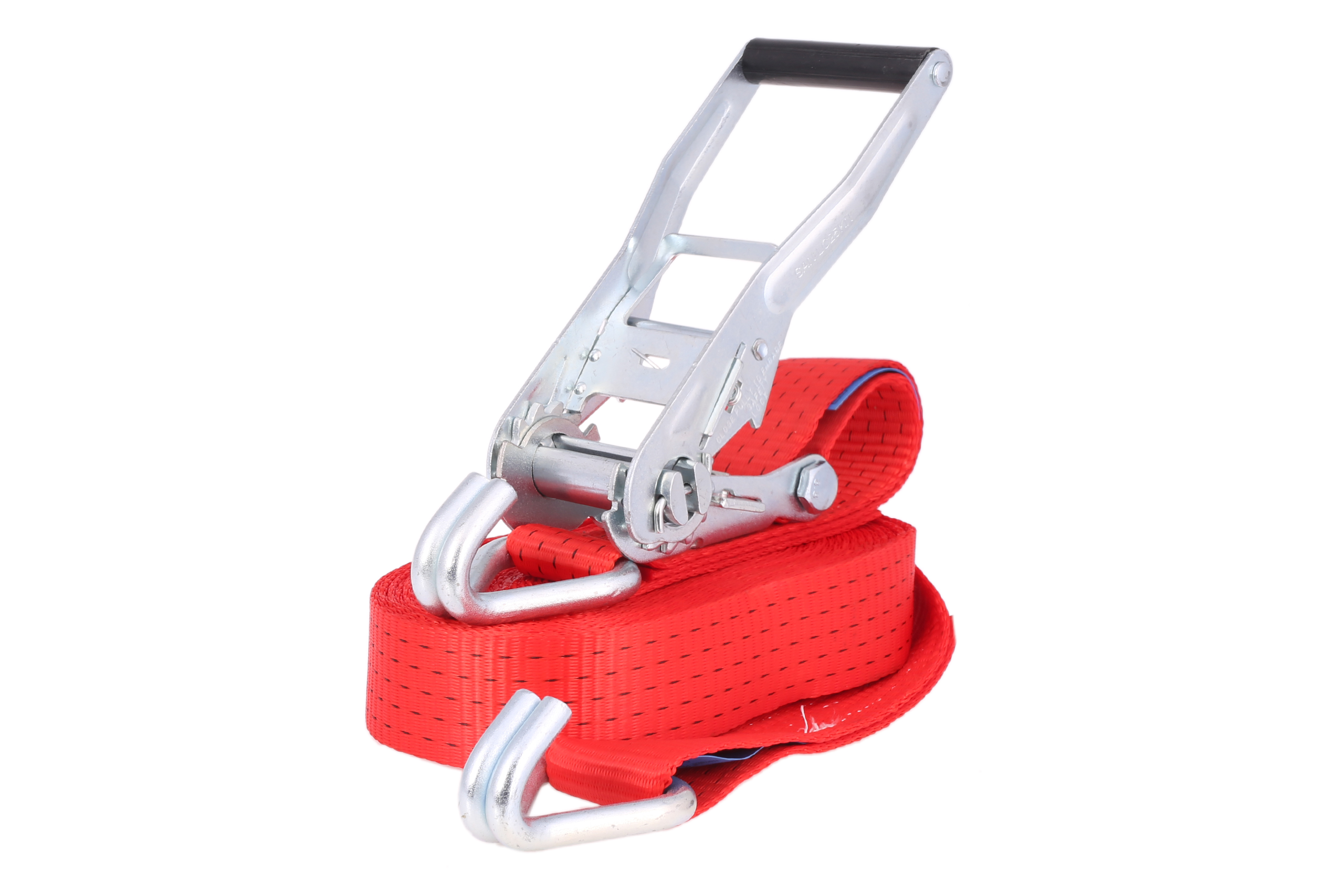
The 12m tensioning strap from Sandax is the perfect solution for everyone who values safe, standard-compliant and reliable load securing – whether in commercial freight transport , in industry , on construction sites or in private areas. With a total length of 12 meters , consisting of a 0.4 m fixed end and an 11.6 m loose end , this two-part 12-meter lashing strap offers excellent reach for bulky or long transported goods . The tensioning strap is manufactured according to DIN EN 12195-2 and is TÜV-certified . The standard ratchet provides powerful pre-tensioning – without any special tools – and enables quick and safe handling even in difficult loading conditions. Thanks to the robust claw hooks on both ends, the strap can be securely attached to lashing points . With a lashing capacity (LC) of 2500 daN in straight pull and an STF (Standard Tension Force) of 350 daN, this 2500 daN tensioning strap is one of the strongest in its class! Technical product details at a glance Length (total) : 12 meters (11.6 m loose end + 0.4 m fixed end) Belt width : 50 mm – robust and tear-resistant Maximum stretch of the webbing : <5% Design : Two-piece with pointed hook Ratchet type : Normal ratchet Lashing force (LC) : 2500 daN in straight pull / 5000 daN in strapping Pre-tensioning force (STF) : 350 daN – for high pre-tensioning of the load Webbing material : High-quality polyester (PES), abrasion-resistant & UV-resistant Standard : DIN EN 12195-2 – permitted for commercial transport TÜV certification : Available Color : Red Packaging units : 6 pieces per carton / 216 pieces per pallet Advantages of this professional lashing strap at a glance ✅ Ideal for large or bulky loads : With a total length of 12 meters, this 12 meter tensioning strap is ideal for securing loads on trucks, trailers or vans - even oversized loads. ✅ Extremely tensile and resilient : With a lashing force of 2500 daN (equivalent to approx. 2500kg), it reliably secures even heavy machinery, steel beams or pallets. ✅ Robust 50 mm webbing : The 50mm tensioning strap is made of particularly durable polyester, which is resistant to abrasion, weather influences and UV radiation. ✅ Certified and compliant with standards : Meets all requirements of DIN EN 12195-2 – for legally compliant use in commercial freight transport. ✅ Easy handling thanks to the normal ratchet : The ergonomically designed ratchet offers fast and powerful pre-tensioning without loss of power. ✅ Universally applicable : The 12m lashing strap is suitable for professional forwarding companies as well as for trades, construction or private transport. Typical applications for 12m lashing straps with 50mm width Freight forwarding & transport logistics : As truck tensioning belts for securing pallets, components, machines and large equipment in long-distance and local transport. Construction & trades : Securing pipes, scaffolding, tool boxes and building materials on trailers or flatbed vehicles. Assembly & event technology : Securing trusses, flight cases and event equipment. Private area & moving : As a 12m tension strap ideal for securing furniture, sports equipment or garden sheds. Instructions for using these tensioning straps Attach the strap to stable lashing points using both hooks. Thread the strap through the ratchet and tighten by hand. Use the ratchet to build up the final tension until the desired preload is reached. To release, simply unlock the ratchet and rewind the strap. A notice : Please check straps regularly for damage and replace them if there is visible wear – this way you can secure your load permanently and in compliance with the law. Sandax – Quality that professionals trust Sandax stands for durable, reliable products in the field of load securing. Whether 12m tensioning straps , anti-slip mats , or clamping bars – all products are manufactured according to strict standards and developed with practical application in mind . The 12m tension strap is a classic for anyone looking for robust, functional and certified equipment . 👉 Order the Sandax lashing strap 12 meters now and achieve transport safety at a professional level. This tensioning strap is TÜV certified according to ISO 9001: Find even more 50mm tensioning straps at Sandax Is this strap not the right length, or are you looking for other 50mm lashing straps ? Simply click the button to go to our category with all 50mm lashing straps . All 50mm tensioning straps at a glance

The Sandax aluminum clamping bar with rubber foot is the perfect solution when it comes to fast, flexible and safe load securing . With a continuously extendable length range of 2350 mm to 2720 mm, this high-quality clamping bar adapts effortlessly to different loading space widths - ideal for vans, box vehicles, trucks or delivery vans . Made from robust aluminium , the clamping bar combines a low weight with an impressive blocking force of approx. 150 daN . The rubberized steel end pieces ensure a firm grip, protect the vehicle walls, and prevent slipping, even on uneven roads or cornering. Technical details at a glance Material : High-quality aluminum, steel end pieces Adjustment range : 2350 mm – 2720 mm, continuously extendable Blocking force : approx. 150 daN End pieces : steel with anti-slip, protective rubber coating Weight : approx. 5.3 kg Application : Mechanical load securing in the vehicle interior Standards : Complies with common standards for load securing Your benefits at a glance ✅ High blocking force for reliable hold : With a blocking force of approx. 150 daN, the clamping bar offers the necessary stability to securely fix pallets, boxes or furniture. ✅ Flexibility for different vehicle sizes : Thanks to the continuously extendable mechanism, the bar can be used in a variety of ways – from small vans to larger trucks. ✅ Gentle, secure hold : The rubberized feet not only prevent slipping, but also protect the surfaces of the vehicle walls and floors. ✅ Robust and durable : Made of aluminum and steel, the beam offers a long service life while being lightweight – ideal for daily use. ✅ Easy to use without tools : The clamping mechanism is designed so that you can fix or loosen the bar quickly and effortlessly – even when wearing gloves. ✅ Reusable and sustainable : Unlike disposable load securing devices, the clamping bar can be used again and again for years. Typical applications for aluminum clamping bars with rubber feet Logistics and forwarding : Securing pallets, boxes or general cargo over short and long distances. Construction and craft industry : securing tools, building materials or machinery during transport on the construction site. Moving and furniture transport : Safe storage for furniture, household items and delicate moving goods. Retail and goods delivery : Avoiding movement of goods during delivery to stores or customers. Application note for clamping bars Adjust the length of the clamping bar to the width of the loading area. Position the beam between the walls by placing the rubber feet on solid ground. Tighten the bar with the mechanism until it is securely locked. Check the stability – adjust if necessary to ensure optimal support. Tip : For maximum safety, combine the clamping bar with additional Sandax load securing elements such as anti-slip mats, tensioning straps or edge protection angles. Why you should buy your clamping bars from Sandax Sandax stands for tested quality, well-thought-out products and real practical suitability . Our clamping bars in the area of mechanical load securing , belt systems and securing solutions help you to avoid transport damage, comply with legal requirements and make your daily work more efficient . 👉 Get the Sandax aluminum clamping bar with rubber foot now – before your next transport! Invest in a product that pays for itself many times over – through durability, safety and ease of use .

Your optimal solution for protecting your cargo with an exceptional level of stability and security. Specially designed for use with webbing straps up to 70mm wide , this robust edge protector offers unparalleled protection for your packages during transport or storage. Made from a tough material, the JUMBO edge protector guarantees durability and resistance to the daily demands of logistics and industry. Using this edge protector minimizes the risk of damage to your products. Whether you're transporting heavy machine parts, delicate furniture , or simply loaded pallets , the JUMBO edge protector fits every need. Invest in the protection of your products and optimize your logistics processes with the JUMBO edge protector from Sandax. When it comes to professional load securing , every detail counts. The JUMBO edge protector made of hard plastic is the ideal solution for protecting the delicate edges of your goods from damage caused by tensioning straps. Technical product details of the JUMBO edge protection angle Material : Hard plastic (impact-resistant & durable) Color : Black Suitable for belt widths : Up to 70 mm Dimensions (approx.) : Width: 135 mm, Depth: 135 mm Application : tensioning belts , conveyor belts Use : Edge protection angle for lashing straps in load securing Advantages of the JUMBO edge protection angle ✅ Extremely durable - Made of durable plastic – ideal for use in commercial freight transport ✅ Universally applicable - Suitable for strap widths up to 70 mm - ideal for wide tensioning straps ✅ Edge protection angle plastic black – unobtrusive, professional look ✅ Weather-resistant & reusable – reliable even in rain, frost or heat ✅ Prevents material damage – distributes the preload force over a large area ✅ Edge protection for lashing straps – increases safety and protects your transported goods ✅ Stable and durable – a reliable companion even with frequent use Areas of application of plastic edge protection angles This plastic edge protection angle is used wherever wide lashing straps encounter sensitive or impact-prone edges. Typical applications: Securing pallet goods and machine parts Protection of wooden, metal or plastic packaging Transport by truck, container or trailer For indoor and outdoor use due to high weather resistance Whether in commercial forwarding or internal factory transport : the edge protection angle for lashing straps not only protects your load, but also your straps - for long-lasting, economical and standard-compliant transport security. Trust in the proven quality of Sandax.

The ideal solution for anyone looking for robust, reliable and at the same time gentle protection for their load securing . Designed for use in demanding conditions, this edge protector offers unsurpassed protection for sensitive edges and surfaces. The "soft" version of this JUMBO edge protector is specially designed to prevent dents and damage. This is especially important for delicate materials, where every scratch or dent can result in significant loss of value. The soft yet resilient nature of the material absorbs shocks and distributes pressure evenly over a larger area, significantly reducing the likelihood of damage during transport. In addition to its practical effectiveness, the JUMBO edge protection angle also scores points for its ease of use. It's quick and easy to install, saving time and speeding up the securing process. The high-quality material guarantees durability , making the edge protector a cost-effective solution for companies of all sizes. Whether for protecting furniture edges , securing building materials on the way to the construction site or securing your goods on pallets , this edge protection angle is the right choice for you! Technical data for the JUMBO cat protection angle Type : JUMBO edge protection angle – soft Material : Soft, durable plastic (LDPE / PIR, 100% recycled) Maximum belt width : Up to 70mm Color : Black Special features : Integrated groove, large contact surface for optimal pressure distribution, side bars for controlled belt guidance, acts as edge glider for higher pre-tension Advantages of soft edge protection ✅ Gentle protection : Soft edge protection : Specially developed to protect sensitive surfaces and prevent pressure points ✅ Effective load securing : Distributes loads evenly, minimizes the risk of damage ✅ Versatile : Suitable for strapping, lashing straps, lashing straps (up to 70mm wide) ✅ Efficiency & Safety : Large contact surface and concave groove ensure safe preload distribution; higher preload forces are possible as edge gliders ✅ Sustainable & robust : Made of 100% recycled plastic, cold-resistant, break-proof, resistant to alkalis and acids ✅ Save time : Quick and easy to install – speeds up the securing process Areas of application of the JUMBO edge protection angle The soft edge protection (JUMBO edge protection angle – soft) is particularly suitable for the following areas: Protection of sensitive goods during transport (e.g. furniture edges, smooth surfaces) Use with strapping or lashing straps to prevent constriction and damage Use as soft edge protectors when loading in warehouses, distribution or on construction sites Use as edge glider in the lashing process to achieve higher pre-tension Conclusion The JUMBO Soft edge protector offers a robust yet gentle solution for secure load securing . Ideal for delicate goods, it's flexible in application and easy to handle. Perfect for use with strapping and tensioning belts .
Edge Protection: Protection for Cargo and Lashing Equipment
Edge protectors and strap protectors perform two functions at the same time: They protect the cargo from pressure marks and protect the lashing strap from abrasion, cuts, or other damage. Edge protection is particularly important for cardboard boxes, pallets, metal parts, timber, concrete products, or packaging with sharp edges.
Without edge protection, a strap can be damaged by an edge or transfer the pre-tensioning force unevenly. This not only causes material wear but can also weaken the entire securing system.
A good practical rule is: Wherever a strap runs over a hard, sharp, or sensitive edge, edge protection should be considered. This extends the service life of lashing straps and improves the quality of the securing system.
Dunnage Bags and Dunnage Cushions: Positive Load Securing for Gaps
Not every load can be secured optimally with lashing straps. Particularly in containers, swap bodies, rail transport, or truck cargo areas, gaps frequently occur between load units. These gaps can become dangerous because cargo may tip, shift, or collide with other goods during movement.
This is where dunnage bags come into play. They are placed in the gaps between load units and inflated with air. This creates positive-fit stabilization between the individual load units.
Dunnage bags are particularly useful when:
- Load units cannot be loaded without gaps
- Sensitive goods should not press directly against each other
- Rows of pallets need to be stabilized
- Containers or trucks are being prepared for longer transport routes
- Recurring packing processes need to be made more efficient
Suitable accessories are also important for professional use, such as filling guns for dunnage bags. These make it possible to inflate dunnage cushions quickly, safely, and in a controlled manner.
Clamping Beams, Load Bars, and Mechanical Load Securing
Mechanical load securing is particularly useful when cargo needs to be supported, blocked, or held in position. Clamping beams, load bars, lashing rails, fittings and attachment points help secure cargo inside the vehicle in a controlled manner.
Clamping beams and load bars are frequently used in box-body trucks, vans, trailers, or swap bodies. They create barriers, prevent movement to the rear or sides, and help divide the cargo area efficiently.
The advantage: Mechanical systems can be installed quickly, are reusable, and are well suited to standardized loading processes. Clamping beams can save considerable time, particularly on routes with multiple stops, partial loads, or recurring loading patterns.
However, the following still applies: Mechanical securing equipment must also be used correctly. The contact surfaces must be suitable, the installation position must be stable, and the vehicle body must be capable of absorbing the forces. VDI 2700 is an important guideline for load securing on road vehicles.
Lashing Rails and Fittings: Creating Flexible Lashing Points
Not every truck is equipped with the ideal number of lashing points as standard. Lashing rails, airline rails, and suitable fittings create flexible attachment options that can be adapted to changing load situations. Such systems are particularly valuable in box-body vehicles, vans, special-purpose vehicles, and service vehicles.
Fittings such as single, double, or quattro fittings provide a flexible connection between the lashing system and the vehicle structure. This allows lashing straps, nets, or other securing elements to be attached exactly where they are needed.
For companies with recurring transport operations, professionally equipping the cargo area can quickly pay off. It reduces the need for improvised solutions, speeds up loading, and improves the reproducibility of load securing.
Frictional, Positive-Fit, or Combined Load Securing?
When using truck accessories, two basic principles are particularly important: frictional and positive-fit load securing.
With frictional load securing, the cargo is pressed against the loading surface through tie-down lashing. This increases friction. Typical equipment includes lashing straps, ratchets, and anti-slip mats.
With positive-fit load securing, the cargo is loaded or blocked in such a way that it cannot move. This can be achieved using front walls, side walls, clamping beams, load bars, dunnage bags, or gap-free loading.
In practice, a combination is often the best solution. For example, a row of pallets is loaded with as few gaps as possible, placed on anti-slip mats, secured with lashing straps, and protected with edge protectors at critical points. Any remaining gaps are filled with dunnage cushions.
This combination is generally more efficient than attempting to secure every load simply by using as many straps as possible.
Checklist: How to Choose the Right Truck Accessories
Before purchasing or using load securing accessories, the specific transport situation should be assessed:
1. Analyze the Cargo
Weight, center of gravity, shape, surface, sensitivity, and packaging determine which accessories are required.
2. Check the Vehicle
Which lashing points, rails, walls, floors, and vehicle structures are available? Are they suitable and sufficiently load-bearing?
3. Determine the Securing Method
Should the cargo be secured by tie-down lashing, direct lashing, blocking, supporting, or positive-fit stabilization?
4. Combine Accessories
Lashing straps, anti-slip mats, edge protection, dunnage bags, and clamping beams often work best when used together.
5. Check the Condition
Damaged straps, illegible labels, deformed fittings, or worn anti-slip mats must not be used.
6. Standardize Processes
Recurring transport operations should use defined loading and securing plans. This saves time and reduces errors.
Common Mistakes When Using Truck Accessories
A common mistake is choosing the cheapest product without considering standards, markings, load capacity, and the intended application. Another mistake is using the wrong combination of equipment: Anti-slip mats are used without sufficient lashing, straps run over sharp edges without edge protection, or dunnage bags are placed in gaps that are too large or otherwise unsuitable.
Damaged accessories are also a safety risk. A lashing strap with a missing or illegible label, cuts, damaged seams, or defective fittings should no longer be used. Information such as LC, STF, SHF, and the applicable standard shown on the label is relevant for safe use.
Professional load securing depends on routine, but it should never become thoughtless. Every load is different. Drivers and loaders should therefore regularly check whether the available equipment is suitable for the actual task.
Buying Truck Accessories: What Companies Should Consider
When purchasing truck accessories for load securing, quality, advice, and availability are key factors. Companies with high transport volumes in particular need reliable products, clear technical specifications, and the ability to combine standard and customized solutions.
Important purchasing criteria include:
- Standards-compliant and tested products
- Suitable load capacity for the intended application
- Robust materials for everyday commercial use
- Clear markings and technical specifications
- Compatibility with existing vehicle and lashing systems
- Availability in larger quantities for fleets, freight forwarders, and logistics centers
- Professional advice for individual load securing requirements
Sandax offers professional load securing accessories for trucks, containers, vans, and other transport applications. From proven lashing straps to mechanical load securing equipment, different securing solutions can be combined to suit the specific application.
Conclusion: The Best Truck Accessories Are the Ones That Match the Load
Truck accessories are far more than just additions to the vehicle. In load securing, they determine whether transport operations can be carried out safely, efficiently, and in compliance with regulations. Lashing straps, anti-slip mats, edge protection, dunnage bags, clamping beams, load bars, lashing rails, and fittings each perform their own functions – and often achieve their full effectiveness only when used in the right combination.
Anyone who approaches load securing professionally should not cut costs on accessories, but select them according to the cargo, vehicle, and transport route. This protects people, goods, and vehicles. At the same time, it improves processes in the warehouse, during loading, and on the road.
Sandax supports companies, freight forwarders, loaders, and drivers with high-quality accessories for professional load securing – from proven lashing straps to customized solutions for complex transport tasks.
Discover suitable truck accessories for professional load securing in the Sandax Shop now.
FAQ: Frequently Asked Questions About Truck Accessories
Which Truck Accessories Are Needed for Load Securing?
The most important accessories include lashing straps, anti-slip mats, edge protectors, dunnage bags, clamping beams, load bars, lashing rails, and suitable fittings. Which products are required depends on the cargo, weight, vehicle body, and securing method.
Are Ratchet Straps and Lashing Straps the Same?
In everyday language, the two terms are often used interchangeably. Technically, the term lashing strap is generally used for textile straps designed for load securing. Important technical values include LC, STF, and SHF, as well as standards-compliant markings.
When Are Anti-Slip Mats Useful in Trucks?
Anti-slip mats are useful when the friction between the loading surface and the cargo needs to be increased. They are frequently used beneath pallets, machinery, crates, or mesh box pallets and are usually combined with additional securing equipment.
Why Is Edge Protection Important When Using Ratchet Straps?
Edge protection protects both the cargo and the lashing strap. It prevents pressure marks, abrasion, and cuts while helping distribute the securing force more effectively across the edges.
Which Is Better: Frictional or Positive-Fit Load Securing?
That depends on the cargo. Frictional securing primarily uses friction and pre-tensioning force, while positive-fit securing relies on blocking the cargo and eliminating gaps. In practice, a combination of both methods is often the safest solution.
Which Regulations Apply to Truck Load Securing?
In Germany, Section 22 of the German Road Traffic Regulations (StVO) is particularly relevant. Cargo must be secured so that it cannot slide, tip over, roll back and forth, or fall from the vehicle even during emergency braking or sudden evasive manoeuvres. Recognized technical standards must also be observed.