
Lashing straps from Sandax - buy certified & safe lashing straps
As we at Sandax focus on both high quality and favourable prices for lashing straps, we have made a name for ourselves with our products and have successfully established ourselves on the market over the last 10 years. All our straps are produced in accordance with DIN EN 12195-2. The DIN standard stipulates that the tension belt must have a maximum elongation of 7%. The majority of Sandax ratchet straps even achieve a maximum elongation of less than 5%. All standard straps from Sandax also have their own TÜV certificate. Our specialisation allows us to achieve economies of scale, which we are happy to pass on to our customers.
The most common lorry & container lashing straps are always available from stock and can be ordered directly from our shop. Customised straps (e.g. automatic tensioning straps or straps with reflectors, clamp lock straps, pressure ratchet or pointed hooks) can also be made up at attractive prices. The belt length, the webbing, the fittings and the ratchet with different pre-tensioning force can be customised according to customer requirements. Customised printing on the lashing straps is also possible from a certain quantity. If you would like to buy customised lashing straps, please contact us at any time by phone or email - we will make you an attractive offer!
Overview of our lashing strap stock range
The following items are always available from stock. If you would like to purchase a lashing strap that is not listed here, please contact us.

4er Set, 3 m Automatik-Zurrgurt, 25 mm, LC 400 daN, mit S-Haken mit Sicherung
Dieses 4er-Set Automatik-Zurrgurte ist die komfortable Lösung für alle, die Ladung schnell, ordentlich und zuverlässig sichern möchten. Jeder Gurt ist 3 m lang, 25 mm breit und verfügt über eine Lashing Capacity von 400 daN. Damit eignet sich das Set ideal für Transporter, Anhänger, Werkstatt, Camping, Umzug, Handwerk und viele alltägliche Sicherungsaufgaben.Der große Vorteil liegt in der integrierten Aufrollautomatik: Kein loses Gurtband, kein lästiges Verknoten, kein „Wo ist jetzt das Ende hin?“-Drama. Der Gurt wird sauber eingezogen und ist nach dem Einsatz direkt wieder ordentlich verstaut. Das spart Zeit, schont die Nerven und macht die Anwendung besonders angenehm — vor allem, wenn Gurte regelmäßig genutzt werden. Die S-Haken mit Sicherung sorgen für eine stabile Verbindung an geeigneten Zurrpunkten und reduzieren das Risiko eines unbeabsichtigten Lösens. Durch die einteilige Ausführung ist der Automatik-Zurrgurt besonders handlich und schnell einsatzbereit. Einfach einhängen, spannen, sichern — fertig.Vorteile auf einen Blick:4er-Set für Kosteneffizienz3 m Länge für flexible Anwendungen25 mm Gurtbreite für kompakte und stabile LadungssicherungLC 400 daN für zuverlässigen Halt bei Transport und LagerungS-Haken mit Sicherung für sicheren Halt am ZurrpunktAutomatische Aufrollfunktion gegen loses, verknotetes Gurtband

4er Set, 3 m Automatik-Zurrgurt, 25 mm, LC 400 daN, mit Spitzhaken
Dieses 4er-Set Automatik-Zurrgurte mit Spitzhaken ist gemacht für alle, die Ladung schnell, ordentlich und zuverlässig sichern möchten — ohne loses Gurtband & Knotenchaos! Die Zurrgurte sind 3 m lang, 25 mm breit und besitzen eine Lashing Capacity von 400 daN. Damit eignen sie sich ideal für die Sicherung leichter bis mittelschwerer Ladung auf Anhängern, in Transportern, im Werkstattbereich, beim Camping oder bei privaten und gewerblichen Transporten. Der besondere Vorteil dieser Variante liegt in den Spitzhaken: Sie lassen sich schnell an geeigneten Zurrpunkten, Ösen oder Halterungen einhängen und bieten eine praktische Verbindung für viele typische Transportanwendungen. Zusammen mit der Automatik-Aufrollfunktion sorgt das für besonders komfortables Handling: Gurt ausziehen, einhängen, spannen — und nach dem Einsatz rollt sich das Gurtband sauber wieder auf. So bleibt der Zurrgurt kompakt, ordentlich und sofort wieder einsatzbereit. Gerade bei regelmäßiger Nutzung spart das Zeit, Platz und Nerven. Kurz gesagt: Dieser Automatik-Zurrgurt bringt Ordnung in die Ladungssicherung — und verhindert, dass dein Gurtband aussieht wie ein schwarzer Spaghetti-Unfall.Vorteile auf einen Blick:4-teiliges Set für Kosteneffizienz3 m Länge für vielseitige Transportaufgaben25 mm Gurtbreite für kompakte und stabile SicherungLC 400 daN für zuverlässigen HaltAutomatische Aufrollfunktion gegen loses oder verknotetes GurtbandSpitzhaken zum schnellen Einhängen an geeigneten Zurrpunkten

4er-Set, Light-Klemmschloss-Zurrgurte, 3 m, 25 mm, LC 250 daN, schwarz
Wenn Ladung sicher sitzen soll, ohne dass gleich schweres Profi-Geschütz aufgefahren werden muss, sind diese Light-Klemmschloss-Zurrgurte im 4er-Set die praktische Lösung. Mit 3 m Länge, 25 mm Gurtbreite und einer Lashing Capacity von 250 daN eignen sie sich ideal zum schnellen Fixieren leichter bis mittelschwerer Gegenstände beim Transport, im Lager, im Hobbybereich oder rund ums Fahrzeug. Das robuste Klemmschloss ermöglicht ein einfaches, schnelles Spannen — ganz ohne Ratsche. Dadurch lassen sich die Gurte besonders komfortabel handhaben, wenn es zügig gehen soll: Gurt durchziehen, festklemmen, fertig. Die schwarze Ausführung wirkt sauber, unauffällig und professionell, während das praktische 4er-Set direkt mehrere Sicherungspunkte abdeckt. Ob Kartons, Kisten, Campingausrüstung, leichte Maschinenkomponenten oder Transportgut im Alltag: Diese Zurrgurte bieten zuverlässigen Halt, flexible Anwendung und eine angenehm einfache Bedienung. Kurz gesagt: klein im Format, stark im Nutzen — und deutlich nützlicher als der berühmte „das hält schon“-Optimismus.Vorteile auf einen Blick:4-teiliges Set für flexible Ladungssicherung3 m Länge für vielseitige Einsatzmöglichkeiten25 mm breites Gurtband für stabile FührungLC 250 daN für leichte bis mittelschwere SicherungsaufgabenKlemmschloss statt Ratsche für schnelle, unkomplizierte HandhabungSchwarze Optik für einen dezenten, professionellen Look

6m lashing strap, 50mm, LC 2500 daN, two-piece, STF 500
With a width of 50mm and a lashing capacity of 2500 daN, you can be confident that your load will be held securely in place, no matter how bumpy the road may be. The Ergo long lever ratchet , which is attached to the fixed end of the strap, allows effortless tensioning and ensures that the strap remains firmly taut. Our 6m long lashing strap not only offers excellent functionality but also meets the highest safety standards . Sandax tensioning straps are not only manufactured according to DIN-EN 12195-2 but are also tested and certified by TÜV. Whether you are a professional truck driver or simply someone who needs to secure goods for a one-off transport, our 6m long tensioning strap offers the perfect solution. 🚚 Note : These straps are suitable for use as truck tensioning straps and meet the current standards for load securing. Find even more 50mm tensioning straps at Sandax Is this strap not the right length, or are you looking for other 50mm lashing straps ? Simply click the button to go to our category with all 50mm lashing straps . All 50mm tensioning straps at a glance

Car transport belt, 3 m, 35 mm, LC 1500 daN, STF 330 daN, with controller
with 3 swivel hooks, length controller: 1.10m ETA value >=0.5 Elongation <=0.4% manufactured according to DIN EN 12195-2 manufactured according to the guidelines of VDI 2700 (sheet 8.1&8.2) 12 pieces per carton / 360 pieces per pallet.
Car transport belt, 3 m, 35 mm, LC 1500 daN, STF 330 daN, with controller 1.15 m - 1.45 m, reinforced edges
with 3 swivel hooks, length controller: 1.15m - 1.45m with reinforced edges ETA value >=0.5 Elongation <=0.4% manufactured according to DIN EN 12195-2 manufactured according to the guidelines of VDI 2700 (sheet 8.1&8.2) 12 pieces per carton / 360 pieces per pallet.
Car transport strap, 3 m, 35 mm, LC 1500 daN, STF 330 daN, with controller 1.45 m, 4 swivel hooks, reinforced edges
with 4 swivel hooks, length controller: 1.45m with reinforced edges ETA value >=0.5 Elongation <=0.4% manufactured according to DIN EN 12195-2 manufactured according to the guidelines of VDI 2700 (sheet 8.1&8.2) 12 pieces per carton / 360 pieces per pallet.

Clamp buckle strap, 3 m, 25 mm, LC 200 daN, one-piece, with Sandax logo
Our clamp lock strap with the Sandax logo is the ideal solution for securely securing your load. Perfect for home use, our durable straps offer a LC value of 200 daN and ensure strong holding power. Our 3m long Sandax clamp lock straps are easily adjustable and feature a practical clamp lock that allows the strap to be tightened quickly and effortlessly . With these practical straps, you'll always feel secure when transporting your load on trailers or similar vehicles.
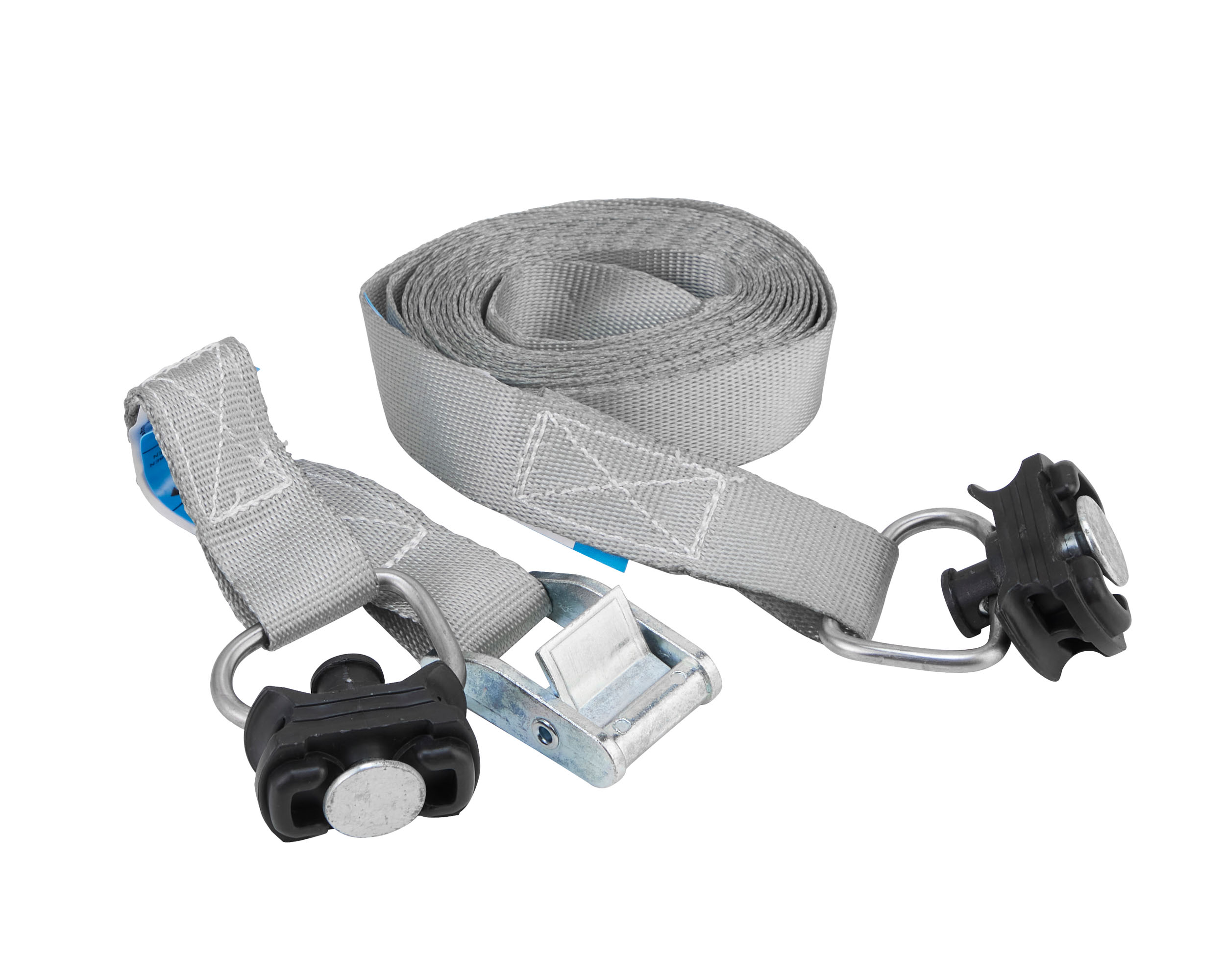
Clamp buckle strap, 3.5 m, 25 mm, LC 250 daN, two-piece, with airline end fitting
Discover the optimal solution for secure and efficient lashing of your load : our cam lock strap . With a length of 3.5 meters and a width of 25 mm, this two-part tensioning strap is the perfect choice for a wide range of applications . It features a maximum tensile force (LC) of 250 daN, making it a reliable aid for securing cargo and equipment. The innovative airline end fitting guarantees particularly quick and easy handling as well as high compatibility with airline rail systems . Whether for professional transport tasks or private use – this cam lock strap offers strength, flexibility and security to reliably secure your load. Don't compromise when it comes to the security of your load.

Clamp buckle strap, 3m, 25mm, LC 500daN, with buckle protection
Secure your load effortlessly with our high-quality cam buckle strap . Measuring 3 meters long and 25 mm wide, this strap is ideal for transporting a wide variety of items safely and securely. It boasts a load capacity of up to 500 daN , so you can rely on its reliability and strength. The integrated buckle protector provides additional security and protection against scratches or damage to your load. Whether for professional use or everyday transport tasks, this cam buckle strap is the perfect solution for securely securing your load.

Clamp buckle strap, 5m, 25mm, LC 500daN, with buckle protection
Secure your load effortlessly with our high-quality cam buckle strap . Measuring 5 meters long and 25 mm wide, this strap is ideal for transporting a wide variety of items safely and securely. It boasts a load capacity of up to 500 daN , so you can rely on its reliability and strength. The integrated buckle protector provides additional security and protection against scratches or damage to your load . Whether for professional use or everyday transport tasks, this cam buckle strap is the perfect solution for securely securing your load.

Combi car transport belt, 2.7m, 50mm, LC 1600 daN, two-piece, STF 300, short lever ratchet
The combo car transport strap is the optimal solution for the safe transport of vehicles. With a length of 2.7 meters and a width of 50 millimeters, this two-part lashing strap system offers robust and reliable load securing for a wide variety of car transport applications. The short-lever ratchet allows for quick and efficient tensioning of the strap. The ratchet is easy to use and ensures reliable securing during transport. With a lashing capacity of 1600 daN, this car transport strap offers the strength and reliability needed to safely secure vehicles. Whether you're transporting a vehicle on a trailer or preparing it for car transport, the combo car transport strap offers the ideal solution for securing loads safely. Trust the quality of this Sandax strap system to ensure your car transport is trouble-free and, above all, safe.

Fixed end, 0.50m, 50mm, LC 2500daN, STF 300daN, short lever ratchet
This festival ensures a outstanding lashing power and is easy to use. With a length of 0.5 meters and a width of 50 mm, it offers a reliable lashing force of 2500 daN . The short lever ratchet makes it easy for the operator to tighten the belt particularly easy. The reliable quality of Sandax ensures that This ratchet meets the high quality requirements for demanding transport loads. In addition, this fixed end is TÜV-certified and Like all our belts, it complies with the requirements of DIN-EN 12195-2 . 🚚 Note : These straps are suitable for use as truck tensioning straps and meet the current standards for load securing. This fixed end is TÜV certified according to ISO 9001:

Fixed end, 0.50m, 50mm, LC 2500daN, STF 500daN, ERGO long lever ratchet
Fixed end, 0.50m, 50mm, LC 2500daN, STF 500daN, ERGO long lever ratchet STF 500 daN, with claw hook 12 pieces per carton / pallet of 480 pieces 🚚 Note : These straps are suitable for use as truck tensioning straps and meet the current standards for load securing.

Lashing strap ERGO LASH, 10m, 50mm, LC 2500daN, STF 300daN, two-piece, short lever ratchet
ERGO LASH LC (Lashing Capacity) 2500 daN in straight pull, STF (Pre-tension force) 300 daN, Stretching strap < 5% Fixed end 0.4 m with claw hook; loose end 9.6 m with claw hook, webbing color: RED manufactured according to DIN EN 12195-2; TÜV certificate VE 256 pieces per pallet
Lashing strap ERGO LASH, 12m, 50mm, LC 2500daN, STF 300daN, two-piece, short lever ratchet
ERGO LASH Stretch webbing < 5%, fixed end 0.4m with pointed hook, loose end 11.6m with pointed hook, webbing colour red, manufactured according to DIN EN 12195-2, TÜV certificate
Lashing strap ERGO LASH, 3m, 50mm, LC 2500daN, STF 300daN, two-piece, short lever ratchet
ERGO LASH LC (Lashing Capacity) 2500 daN in straight pull, STF (Pre-tension force) 300 daN, Stretching strap < 5% Fixed end 0.4 m with claw hook; loose end 2.6 m with claw hook manufactured according to DIN EN 12195-2; TÜV certificate VE 10 pcs in carton - 48 carton on pallet.
Lashing strap ERGO LASH, 6m, 50mm, LC 2500daN, STF 300daN, two-piece, short lever ratchet
ERGO LASH LC (Lashing Capacity) 2500 daN in straight pull, STF (Pre-tension force) 300 daN, Stretching strap < 5% Fixed end 0.4 m with claw hook; loose end 5.6 m with claw hook manufactured according to DIN EN 12195-2; TÜV certificate Color: red 1 Pallet=400 pieces, 10 pieces/carton
Lashing strap ERGO LASH, 8m, 50mm, LC 2500daN, STF 300daN, two-piece, short lever ratchet
ERGO LASH LC (Lashing Capacity) 2500 daN in straight pull, STF (Pre-tension force) 300 daN, Stretching strap < 5% Fixed end 0.4 m with claw hook; loose end 7.6 m with claw hook manufactured according to DIN EN 12195-2; TÜV certificate Color: red 1 Pallet=320 pieces, 10 pieces/carton
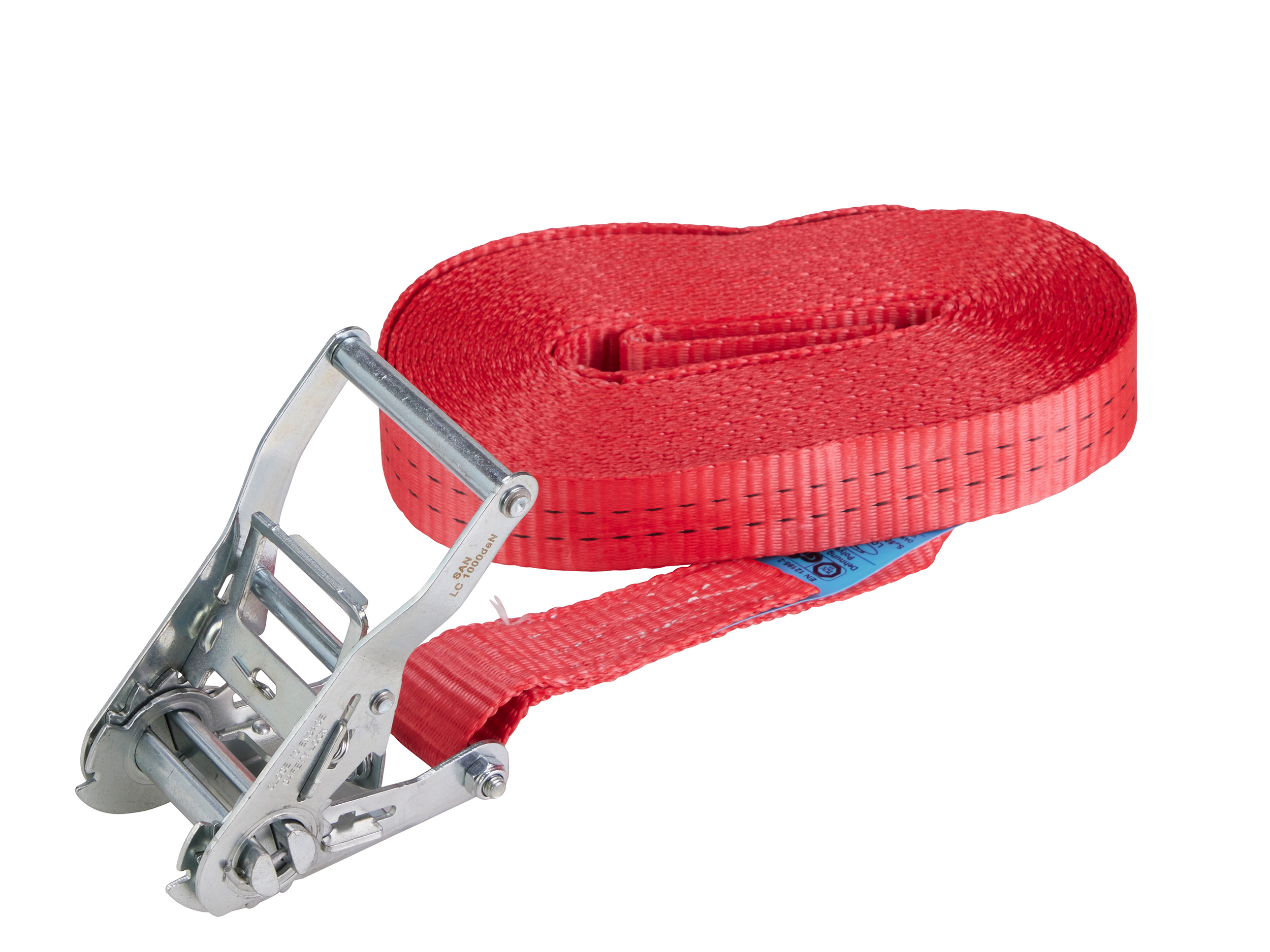
Lashing strap, 10m, 35mm, LC 2000daN, STF 200daN, one-piece, standard ratchet
Whether for professional freight transport or private use, proper load securing is crucial. The one-piece lashing strap from Sandax , measuring 10 meters long and 35 mm wide, is ideal for securing boxes, machinery, furniture, and much more. With a lashing capacity (LC) of 2000 daN and a standard pre-tension force (STF) of 200 daN, this strap is suitable for a wide range of applications and ensures maximum safety during transport . The integrated standard ratchet made of robust steel allows for quick and easy application. Technical product details at a glance Design : One-piece with standard ratchet Length : 10 meters Width : 35 mm Lashing force (LC) : 2000 daN (straight pull) Preload force (STF) : 200 daN Material : High-strength, UV-resistant polyester Color : Red Certified : According to DIN EN 12195-2, TÜV and GS tested Labelling : Permanently sewn with all required safety information Your benefits at a glance ✅ Versatile – ideal for transport with trailers, vans, trucks or in the workshop ✅ 10 meters long – ideal for securing large or bulky loads ✅ Easy handling – thanks to the ergonomic standard ratchet with high operating comfort ✅ Durable & weatherproof – the polyester webbing is resistant to moisture, UV rays and abrasion ✅ Certified & compliant with standards – meets all requirements of DIN EN 12195-2, for safe use in commercial transport ✅ Cost-effective & reusable – long service life when used properly ✅ Safety label on the belt – with information on LC, STF, manufacturer and standard for quick check Typical applications for the 10m tensioning strap from Sandax Transport security in commercial freight transport Fastening furniture, pallets or machines Securing building materials on flatbed trucks and trailers Use by forwarding companies, tradesmen, event logistics or private removals Why Sandax? Sandax stands for quality, reliability, and safety in the field of load securing . With decades of experience and certified products, Sandax is one of the leading suppliers in Germany. Every lashing strap is tested and meets the highest standards – for your safety on the road. Order now and transport safely Rely on proven brand quality from Sandax – and ensure a secure hold during every transport. Combine the strap with other Sandax products such as edge protectors , storage bags , or anti-slip mats for a professional securing system. This tensioning strap is TÜV certified according to ISO 9001: Find even more 35mm tensioning straps at Sandax Is this strap not the right length, or are you looking for other 35mm lashing straps ? Simply click the button to go to our category with all 35mm lashing straps . All 35mm tensioning straps at a glance

Lashing strap, 10m, 50mm, LC 2500 daN, two-piece, STF 500, ERGO long lever ratchet
With a length of 10 meters, a width of 50 millimeters and a lashing capacity of 2500daN, this two-part lashing strap stands for strength and reliability. What makes this lashing strap special is the ERGO long-lever ratchet , which not only embodies technological advancement but also offers unique ergonomics. With this ratchet, lashing and securing your load becomes an effortless task. Sandax stands not only for performance, but also for first-class workmanship and durability – the lashing strap is a reliable companion for all your demanding transport tasks. If you're looking for the highest quality, innovative design, and uncompromising safety , the two-piece Sandax 10m ERGO lashing strap is your best choice. Invest in the safety of your cargo and trust in Sandax quality. 🚚 Note : These straps are suitable for use as truck tensioning straps and meet the current standards for load securing. This tensioning strap is TÜV certified according to ISO 9001: Find even more 50mm tensioning straps at Sandax Is this strap not the right length, or are you looking for other 50mm lashing straps ? Simply click the button to go to our category with all 50mm lashing straps . All 50mm tensioning straps at a glance

Lashing strap, 10m, 50mm, LC 2500daN, STF 350daN, two-piece, short lever ratchet
This two-part lashing strap is the perfect solution for demanding transport requirements. With a length of 10m, a width of 50mm and a lashing capacity of 2500daN , this strap is the perfect companion for any transport. The short lever ratchet allows for quick and easy handling to secure your load safely and securely. Sandax stands for the highest quality and reliability . This tensioning strap impresses not only with its performance, but also with its robust workmanship and durability . Rely on Sandax to transport your cargo safely, stably and safely. This 10m tensioning strap is the perfect choice for all your transport needs - invest in quality and play it safe with Sandax! 🚚 Note : These straps are suitable for use as truck tensioning straps and meet the current standards for load securing. This tensioning strap is TÜV certified according to ISO 9001: Find even more 50mm tensioning straps at Sandax Is this strap not the right length, or are you looking for other 50mm lashing straps ? Simply click the button to go to our category with all 50mm lashing straps . All 50mm tensioning straps at a glance

Lashing strap, 10m, 50mm, LC 2500daN, STF 500daN, two-piece, long lever ratchet
LC (Lashing Capacity) 2500 daN in straight pull, STF (Pre-tension force) 500 daN, Stretching webbing < 5% fixed end 0.4 m with claw hook; loose end 9.6 m with claw hook; pressure ratchet manufactured according to DIN EN 12195-2; TÜV certificate 🚚 Note : These straps are suitable for use as truck tensioning straps and meet the current standards for load securing. Find even more 50mm tensioning straps at Sandax Is this strap not the right length, or are you looking for other 50mm lashing straps ? Simply click the button to go to our category with all 50mm lashing straps . All 50mm tensioning straps at a glance

Lashing strap, 10m, 50mm, LC 5000 daN, one-piece, STF 300, short lever ratchet
Don't worry about the safety of your goods ! Our 10m lashing strap, 50mm wide and with a lashing capacity of 5,000 daN, ensures your cargo remains secure. This one-piece, 10m long tensioning strap is manufactured according to DIN EN 12195-2 and is TÜV-certified, so you can expect the highest quality and reliability. Its robust short-lever ratchet ensures easy and comfortable handling. Ensure your cargo is safe and secure with this 10m Sandax lashing strap . 🚚 Note : These straps are suitable for use as truck tensioning straps and meet the current standards for load securing. Find even more 50mm tensioning straps at Sandax Is this strap not the right length, or are you looking for other 50mm lashing straps ? Simply click the button to go to our category with all 50mm lashing straps . All 50mm tensioning straps at a glance
What are lashing straps?
Tensioning straps are indispensable tools for professional load securing. They usually consist of a robust webbing strap and a ratchet or clamp lock with which the straps can be tightened. Their main purpose is to securely fix goods and merchandise during transport to prevent them from slipping, tipping over or falling.
Thanks to their high load-bearing capacity and easy handling, tension belts are used in many areas - from private removals to commercial goods transport. They make a decisive contribution to preventing transport damage and ensuring safety on the road, rail or sea. There are different types of lashing straps, e.g. with ratchet, clamp lock or as a two-part version with hook. The right solution can be selected depending on the weight and nature of the load
The advantages of dunnage bags at a glance
- Reliable securing of the load
- Protection against slipping, tipping and transport damage
- Increased road safety
- Easy handling and quick application
- Versatile use (private & commercial)
- Durable thanks to robust materials
- Compliance with legal regulations on load securing
- Preservation of insurance cover
- Reduction of accidents and damage
Tensioning straps and lashing straps are essential aids when it comes to safely transporting loads on
vehicles. Whether it's lorry transporters, motorbikes or heavy loads, the right straps can make the
difference between safe transport and a potentially dangerous incident.
Buying lashing straps for different applications
When selecting lashing straps, it is important to find the right strap for the intended use. Lorry lashing
straps and heavy-duty lashing straps are specially designed to withstand high tensile forces and
securely fix heavy loads. At Sandax, these straps comply with DIN EN 12195-2, which means that they
must fulfil strict requirements in terms of material strength and lashing force.
For lighter transports, such as the transport of motorbikes, for example Motorbike lashing straps are
the ideal choice. These straps are often narrower and easier to handle, but offer sufficient support to
securely fasten the motorbike. Particularly practical here are Tensioning straps with hooks
which enable quick and easy fastening. However, in other areas of application Lashing straps without hooks
make sense. When buying lashing straps for lorries, make sure you choose the right
lashing force and the right length. For some applications Lashing straps with special fittings make sense.
The advantages of lashing straps for load securing
Lashing straps are indispensable tools for the secure fastening of loads during transport. They offer numerous
advantages that make them a favoured choice in various applications. Here are some of the key benefits
that lashing straps offer:
1. High load capacity and reliability
Tensioning straps are made of robust materials that ensure high tensile strength and resistance to abrasion. These
straps are designed to remain reliable even under extreme conditions and loads. Heavy-duty tension belts in
particular are able to withstand high forces and are therefore ideal for transporting heavy goods.
2. Easy handling and versatility
A major advantage of lashing straps is their ease of use. The lashing straps are equipped with ratchets or hooks,
which enable quick and secure fastening. Ratchet lashing straps offer the added benefit of being easy to tighten and
loosen, making load securing particularly efficient. These straps are extremely versatile and can be used in a
variety of situations, from transporting motorbikes to heavy machinery.
3. Safety and legal compliance
Lashing straps make a significant contribution to safety in transport. They prevent loads from slipping, tipping or
even falling, which not only protects the transported goods but also prevents accidents. In Germany and the EU,
tension belts are subject to strict standards and regulations, such as DIN EN 12195-2, which ensures that the belts
meet the highest safety standards and are legally compliant when used correctly.
4. Durability and cost savings
Thanks to their robust construction, tension belts have a long service life if they are properly maintained and
stored. Regular inspections and proper storage can further extend the service life and reduce the need for frequent
replacement purchases. This results in long-term cost savings for companies that rely on tension belts on a regular
basis.
5. Flexibility of use
Tensioning straps are available in various lengths, widths (e.g. Tension belts 25mm,
35mm tension belts
& Tension belts
50mm) and versions are available so that they can be flexibly adapted to the respective requirements. From
lorry lashing straps to motorbike lashing straps, there is a suitable solution for every transport task. This
flexibility makes lashing straps an indispensable aid for a wide range of transport tasks.


Robust and reusable lashing straps for motorbike transport.

Clamp lock straps for securing roof boxes on the car.

Tensioning straps with hooks for securing loads in private and commercial goods transport.

Buy lashing straps without hooks
Tensioning straps without hooks for securing loads in private and commercial goods transport.

Professional lashing straps for securing car transports.

Automatic lashing straps for quick securing of simple loads.
Legal basis and standards
Explanation of the most important terms in connection with
lashing straps
DaN (decanewton)
This is the unit used to specify the tensile strength of belts and ropes.
LC (Lashing Capacity)
This value, expressed in DaN (decanewtons), indicates the lashing capacity of a lashing strap. An LC value of 2500 DaN corresponds to a lashing capacity of 2.5 tonnes. The breaking load of tension belts manufactured in accordance with the DIN standard (EN12195-2) is twice the lashing force. An LC of 2500 daN therefore corresponds to a breaking load of 5000 daN. There is therefore always a safety factor of 2 :1.
LC in straight pull / LC in strapping
Every strap approved in Germany has a label on which states, among other things, the breaking load or tensioning force and the pre-tensioning force of the ratchet . The most important information is the maximum tensioning force (LC value). A distinction is made here as to whether the lashing strap is tensioned straight (straight pull) or is tensioned over a package(strapping). In the case of one-piece belts, the belt is even placed around a package (strapping/loop) - the value of the strapping also applies here.
The lashing capacity in the strapping is generally twice as high as the LC in the straight pull. For two-part belts , only the LC value in the straight pull is specified in accordance with the standard. For one-piece belts, however, only the LC value in the strapping is specified.
STF - Standard Tension Force
STF stands for Standard Tension Force or pre-tensioning force. A value that is often neglected, but is important for finding the right belt for the intended use. The STF value indicates the tension force with which a belt can be pre-tensioned with the installed ratchet.The longer and more stable the installed ratchet is, the higher the pre-tensioning force. Long-lever or ergo ratchets therefore have a higher pre-tensioning force per sethan standard ratchets. Due to the greater leverage of the longer ratchet, more force can be transferred to the tension of the belt by hand. Standard tensioning straps have an STF value of 300-350 daN, while long lever or ergo lashing straps have an STF value of 500-550 daN.
One-piece ratchet strap / lashing strap
Heavy-duty lashing straps with a sewn-on ratchet. The strap is placed around the package and the end of the strap is inserted back into the ratchet. The ratchet is operated and the strap is tensioned.
Two-part ratchet strap / tensioning strap
The two-part tensioning belt has a fixed end (short end with a hook or other fitting that is sewn to the ratchet) and a loose end. The loose end is a webbing strap with a J-hook or other fitting sewn to the end. You can find more information in our lashing strap instructions.
Lashing strap designation according to DIN EN 12195-2:2001
Frequently Asked Questions About Lashing Straps and Tie-Down Straps
Below you will find important questions and answers about lashing straps, tie-down straps, ratchet straps, and their use in professional cargo securing.
What is the difference between lashing straps and tie-down straps?
The terms lashing strap and tie-down strap are often used interchangeably. Both refer to textile webbing systems used to secure loads such as packages, machinery, pallets, vehicles, and other goods against shifting, tipping, or falling during transport.
Which tie-down straps are suitable for trucks, vans, and shipping containers?
For trucks, vans, and shipping containers, heavy-duty lashing straps with ratchets and suitable end fittings are commonly used. Key selection criteria include the required length, webbing width, lashing capacity (LC), pre-tensioning force, and available lashing points. Heavier loads generally require straps with a higher LC rating, while lighter loads can often be secured with narrower tie-down straps.
What does LC mean on a lashing strap?
LC stands for Lashing Capacity and indicates the permissible tensile load of a lashing strap. The LC value is stated in daN (decanewtons) and is one of the most important markings when choosing a tie-down strap. A higher LC rating indicates greater load capacity. The required LC depends on the weight of the cargo, the lashing method, the coefficient of friction, the lashing angle, and the forces expected during transport.
Why is pre-tensioning force important for ratchet straps?
Pre-tensioning force describes the force with which a ratchet strap presses cargo against the loading surface during tie-down lashing. Greater pre-tensioning force can increase friction between the load and the loading surface, improving the securing effect. For load securing in accordance with applicable standards, pre-tensioning force, the number of straps, the coefficient of friction, and cargo weight must always be considered together.
What does DIN EN 12195-2 require for lashing straps?
DIN EN 12195-2 defines requirements for web lashing assemblies made from man-made fibres used for load securing. These include labelling, load capacity, elongation, testing, and safety-related characteristics. Sandax lashing straps are manufactured in accordance with this standard, which specifies a maximum elongation of 7% at LC.
When should I use a one-piece lashing strap?
A one-piece lashing strap consists of continuous webbing with a tensioning device but without separate hooks at either end. It is often used to strap, bundle, or hold loads together. One-piece tie-down straps are particularly practical when goods need to be wrapped directly and separate lashing points are not required.
When is a two-piece lashing strap the better choice?
A two-piece lashing strap consists of a loose end and a fixed end with a ratchet, usually with end fittings such as hooks on both ends. It is particularly suitable for securing cargo to fixed lashing points in trucks, trailers, vans, or containers. Two-piece ratchet straps are commonly used for tie-down lashing or direct lashing on a loading platform.
What role do hooks and end fittings play in tie-down straps?
Hooks and end fittings connect the tie-down strap to the lashing point. Depending on the vehicle, loading surface, and lashing point, J-hooks, claw hooks, S-hooks, carabiner-style hooks, or other fittings may be suitable. The hook must fit the existing lashing point securely and meet the required load capacity.
When are retractable ratchet straps a good choice?
Retractable ratchet straps are particularly useful when straps are frequently attached, released, and stored again. The webbing rewinds automatically, reducing loose strap ends and making handling faster. They are suitable for vans, trailers, motorcycle transport, recreational transport, and routine loading operations.
What are cam buckle straps suitable for?
Cam buckle straps are primarily used for lighter securing tasks that do not require the high tension of a ratchet. They are commonly used to bundle, hold in place, and secure smaller or delicate items. For heavy loads or where higher securing forces are needed, ratchet straps with the appropriate lashing capacity are generally the better choice.
Can I order lashing straps in custom lengths or with special fittings?
Yes, Sandax can supply custom-made lashing straps. Depending on your requirements, the strap length, webbing, ratchet, pre-tensioning force, and end fittings can be customized. Options include specific hooks, push-type ratchets, reflective elements, special lengths, or designs for recurring transport processes.
Can tie-down straps be printed with my company logo?
From a certain minimum order quantity, lashing straps can be custom printed. Printing a company name, logo, or identification mark can help assign straps to the correct equipment, prevent mix-ups, and improve brand recognition across a vehicle fleet or warehouse. Sandax can provide a tailored quotation for branded tie-down straps.
How can I tell when a lashing strap needs to be replaced?
A lashing strap must be replaced if its webbing, stitching, ratchet, or end fittings are damaged. Warning signs include cuts, severe abrasion, deformation, corrosion, damaged hooks, illegible labels, or torn stitching. Damaged tie-down straps must not be used for cargo securing.
Can I buy lashing straps directly from Sandax?
Yes, you can buy lashing straps, tie-down straps, ratchet straps, retractable tie-down straps, cam buckle straps, and matching accessories directly from Sandax. Many common truck and container lashing straps are available from stock. For custom-made products, larger quantities, or special requirements, Sandax offers expert advice and individual quotations.
Important standards and regulations
In Germany, lashing straps and lashing belts for lorries are subject to strict
legal regulations. DIN EN 12195-2 specifies the requirements for lashing straps in terms of
material quality and load-bearing capacity. Furthermore, companies must ensure that their lashing straps
are regularly inspected by competent persons. This is not only essential for the safety of the load, but
also to avoid fines.
Overall, when it comes to securing loads with lashing straps, it is essential to use high-quality products and to use them in accordance with current safety regulations. With the right tension belts and lashing straps that meet the specific requirements, you can ensure that your load is optimally secured at all times.
Correct use of lashing straps
The correct use of lashing straps is crucial for effective load
securing:
- Preparation: Check the lashing strap for damage such as tears or
deformation before each use. Belts with defects should not be used.
- Attaching the belt: Position the belt so that it securely encloses the
load. Make sure that the belt is not twisted.
- Tensioning the belt: Use the tensioning element (e.g. ratchet) to
tighten the belt. Take care not to exceed the recommended manual force in order to avoid
damage.
- Check: After tensioning, the load should be firmly secured with no
room for movement. Check the tension regularly, especially for longer journeys.
Care and maintenance of lashing straps
- Storagestore the straps in a dry, cool place, protected from direct sunlight and moisture.
- Regular inspection: Check the straps for signs of wear, such as fraying or damage to the
fittings.
- Accessories: With the right tensioning strap accessories, you can significantly extend the service life of the straps
Conclusion: Buying lashing straps for professional load securing
Those looking to purchase lashing straps that meet the highest safety and quality standards will
find a reliable selection for almost every field of application at Sandax. From standard passenger car
transport to robust heavy-duty lashing straps for professional freight transport, our
products offer a standard-compliant, durable, and field-proven solution for load securing.
Thanks to certified materials, clear labeling, and various lengths, widths, and tensile strengths, the
lashing straps can be precisely tailored to specific transport requirements. Especially in commercial use,
truck lashing straps according to EN 12195-2 ensure maximum safety, efficiency, and legal
compliance.
By choosing Sandax, you are opting for lashing straps that deliver outstanding performance in daily operations – reliable, heavy-duty, and designed for a long service life.