
Order Textile Lifting Technology in the Sandax Online Shop
Whenever something needs to be moved onto a transport medium for transport, special lifting technology is required. Depending on the area of application, this must meet different requirements. Our textile lifting technology meets the highest demands for your lifting applications. You can use it for a wide variety of purposes. Such textile lifting equipment is particularly popular for reloading.
If you require large quantities, you can request an individual quote from us at any time. For normal orders, please use the ordering function directly in our textile lifting technology online shop.
Textile Lifting Equipment, Slings, Lifting Straps, Eye-to-Eye Slings
All articles of the main category textile lifting technology are listed below. They can be filtered using the filter criteria. Is what you are looking for not there? Then contact us.

Polyester round sling, 1m/2m, WLL 1to, single-layer
The 1t round sling from Sandax is your reliable and versatile lifting device for professional lifting and transport tasks . Made of robust polyester and certified according to EN 1492-2 , this round sling impresses with its superior quality and a load capacity of 1,000 kg . Versatile for every lifting and securing requirement This single-layer purple round sling is specially designed for all areas where loads must be moved safely and efficiently: from mechanical engineering to construction sites, logistics and warehouses, to workshops and assembly. The clearly recognizable purple color – standardized according to EN 1492-2 – immediately indicates that this round sling is suitable for loads up to 1 t . This makes work not only safer but also more efficient, minimizing misuse. Product details at a glance Load capacity : 1,000 kg (WLL 1 t), tested and certified according to EN 1492-2 Length : Usable length 1m / circumference 2m – flexible use for a wide range of requirements Construction : Single-layer, lightweight and space-saving, easy to handle Material : 100% high-quality polyester, resistant to abrasion, moisture and UV rays Color : Purple - ensures quick identification and prevents confusion Protection : Smooth surface and solid protective cover – protects delicate loads and the fibers Temperature range : -40°C to +100°C – fully operational in a wide range of conditions Standard & Safety : Manufactured and tested according to EN 1492-2; safety factor 7:1 Packaging unit : 1260 pieces per pallet Advantages of Sandax Polyester Round Slings ✅ Fast and secure product identification : Thanks to the purple color, you can see the correct load capacity of your round sling at a glance – ideal for greater efficiency and safety. ✅ Comfortable use : The round sling is particularly easy to guide and place – even in narrow or hard-to-reach areas. ✅ Durability : The purple textile round sling is extremely durable, protects the load-bearing fibers and maintains its tear resistance even under heavy use. ✅ Maximum safety : A strict testing process and production according to standards offer you and your employees reliable protection in daily use. ✅ Gentle use : Perfect for sensitive surfaces as the polyester fibers do not damage edges or leave marks. Typical applications of round slings Construction & assembly : Safe lifting of steel beams, building elements and machinery. Logistics & Transport : Ideal for moving wooden beams, pallets, wire mesh boxes and goods in storage and shipping. Workshop & Maintenance : Flexible round slings for quick access and multiple uses during machine servicing and repair work. Why buy round slings from Sandax? You receive proven brand quality directly from the experts in textile lifting technology and load securing . Your advantages: Fast delivery, generally immediate availability, and personalized expert advice upon request . Buy your 1m/2m 1t round sling from Sandax and work with maximum safety and flexibility .

Polyester round sling, 1m/2m, WLL 2to, single-layer
single-layer according to EN 1492-2 Safety factor 7:1 Color: green 720 round slings per pallet

Polyester round sling, 2.5m/5m, WLL 1to, single-layer
Round sling according to EN 1492-2 Safety factor 7:1 Color: purple 540 pieces per pallet
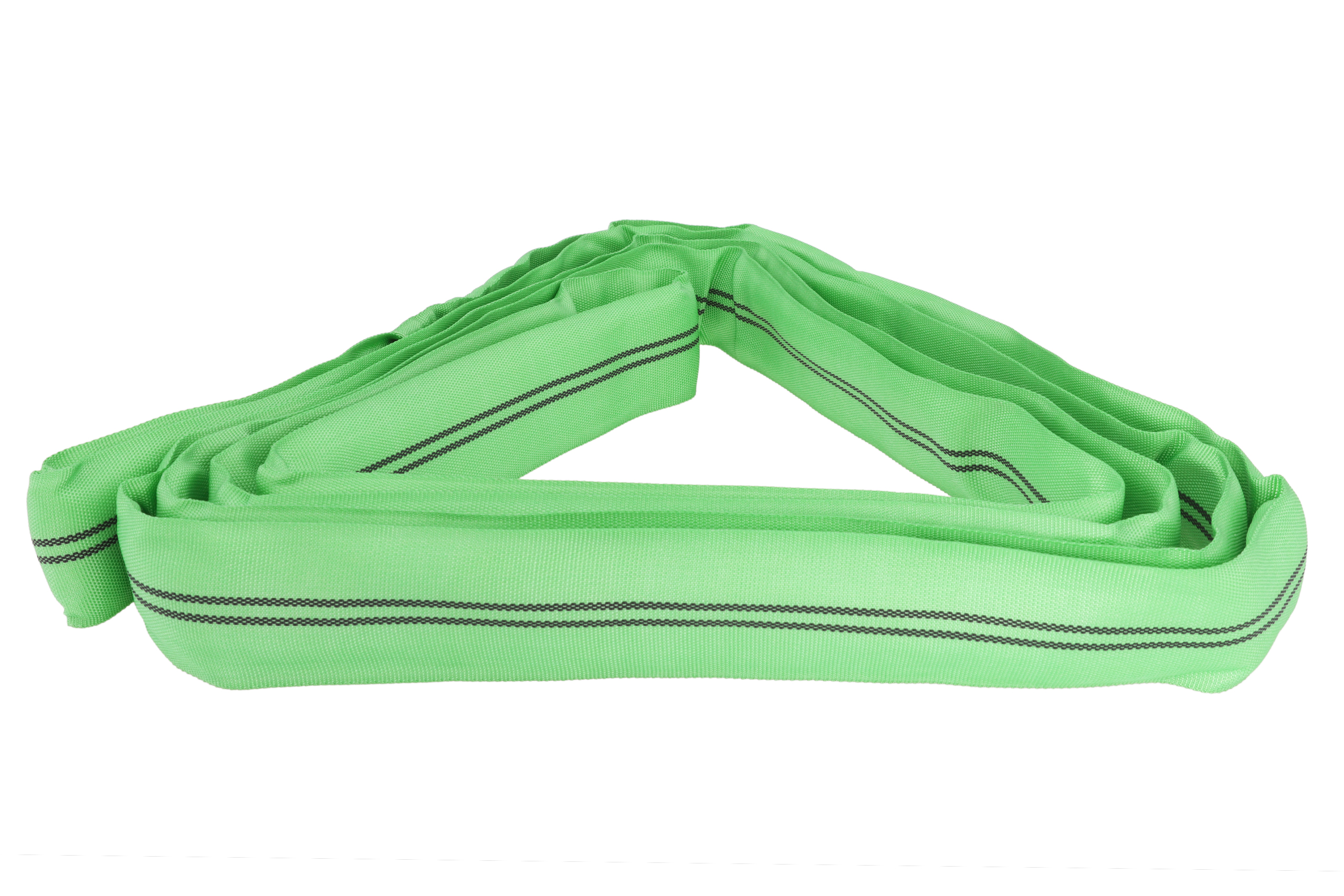
Polyester round sling, 2.5m/5m, WLL 2to, single-layer
Round sling according to EN 1492-2 Safety factor 7:1 VE=20 sets of 1 piece/carton

Polyester round sling, 2.5m/5m, WLL 3to, single-layer
according to EN 1492-2 Safety factor 7:1 270 pieces per pallet

Polyester round sling, 2m/4m, WLL 2to, single-layer
single-layer according to EN 1492-2 Safety factor 7:1 Color : green 450 pieces per pallet

Polyester round sling, 3.5m/7m, WLL 2to, single-layer
according to EN 1492-2 Safety factor 7:1

Polyester round sling, 3m/6m, WLL 2to, single-layer
according to EN 1492-2 Safety factor 7:1 VE=16 sets of 1 piece/carton

Polyester round sling, 4.5m/9m, WLL 2to, single-layer
Round sling according to EN 1492-2 Safety factor 7:1 VE=10 sets of 1 piece/carton

Polyester round sling, 4m/8m, WLL 2to, single-layer
Round sling according to EN 1492-2 Safety factor 7:1 VE=10 sets of 1 piece/carton
Polyester round sling, 4m/8m, WLL 3to, single-layer
Single-layer round slings according to EN 1492-2 Safety factor 7:1 Color : yellow 180 pieces per pallet, 10 pieces per carton

Polyester round sling, 5m/10m, WLL 2to, single-layer
Round sling according to EN 1492-2 Safety factor 7:1 VE=8 sets of 1 piece/carton

Polyester round sling, 6m/12m, WLL 2to, single-layer
single-layer according to DIN EN 1492-2 Color: green 360 pieces per pallet

Set of 2 lifting straps 2m, WLL 1to, with reinforced loops
- Lifting strap color : purple - Width : 30mm - Length : 2m - Load capacity : 1000kg, U-shape: 2000kg - according to NEN-EN 1492-2


Set of 2, polyester round slings, 1m/2m, WLL 1to, single-layer
according to EN 1492-2, safety factor 7:1 purple with black seams PU=32 sets of 2 pieces/box, 768 sets/pal

Set of 2, polyester round slings, 2.5m/5m, WLL 1to, single-layer
With our high-quality set of two polyester round slings Ensure your lifting tasks are completed safely and efficiently! Both slings are made of single-ply polyester, making them strong and durable. They offer a rated load capacity of 1000kg and a working length of 2.5m , allowing you to easily transport and lift all types, shapes, and sizes. Additionally, these round slings are easy to transport and store. Invest in this reliable round sling set today and ensure your next lifting job is a complete success!

Set of 2, polyester round slings, 2m/4m, WLL 1to, single-layer
Our set of two single-ply polyester round slings is the perfect solution for your application needs . With a circumference of 4 m and a working length of 2 m , their rated load is 1000 kg , making them versatile and robust. Simply attach the slings to each end of the lifting gear and you're ready to go. Their durability makes them ideal for lifting applications . Invest in reliable safety today with our set of two polyester round slings !

Set of 2, polyester round slings, 2m/4m, WLL 2to, single-layer
The set of two polyester round slings from Sandax impresses with its tested quality, high load capacity and universal application possibilities. With a usable length of 2 meters (corresponds to a circumference of 4 meters ) and a load capacity of 2,000 kg (2t / 2 tons), this set is ideal for professional lifting and sling work in industry, trade, warehouses and on construction sites . Each round sling complies with the European standard EN 1492-2 , has a safety factor of 7:1 , and is immediately recognizable as a 2t round sling thanks to its eye-catching color coding . This makes it not only powerful but also particularly safe to use . Technical product data in detail Product type : Round sling, single layer Scope of delivery : 2 pieces (in a practical set) Usable length : 2 m (circumference 4 m) Load capacity (WLL) : 2,000 kg (2 t) Colour : Green (colour code according to EN 1492-2 for WLL 2 t) Material : 100% Polyester (PES), single-layer, abrasion-resistant & UV-resistant Standard : EN 1492-2 Safety factor : 7:1 Temperature range : –40 °C to +100 °C Marking : Sewn-in safety label with WLL, standard and manufacturer Your benefits at a glance ✅ Certified safety : Thanks to production according to EN 1492-2 and a safety factor of 7:1, the round slings are also ideal for continuous commercial and industrial use. ✅ High load capacity – compactly packed : The 2t round sling is perfect for lifting heavy loads and is still light, flexible and can be stored in a space-saving manner. ✅ Resistant materials : Made of durable polyester, the 2m round sling and the resulting 4m loop size are robust against UV light, moisture, abrasion and chemicals. ✅ Quick visual recognition thanks to color code : The green round sling signals its load capacity at a glance – this minimizes sources of error in hectic everyday work. ✅ Versatile and gentle on the load : The textile loop adapts perfectly to sensitive surfaces and leaves no pressure marks – unlike chains or wire ropes. ✅ Practical set of 2 for flexible use : Two identical slings – ideal for symmetrical attachment or as a reserve for daily use. Typical applications of round slings Construction & Assembly : Safe lifting of structural steel, precast concrete elements, formwork elements or equipment Industry & Production : Positioning and moving heavy machine parts or units Warehouse & Logistics : Loading pallets, transport containers or bulky goods Trade fair and event technology : Hanging trusses, lighting equipment or decorative elements Crafts & Workshop : Flexible attachment for repair, maintenance and transport work Instructions for the use of round slings Check round slings regularly for cuts, damage or abrasion Do not guide over sharp edges – if necessary, use edge protection Maintain the pulling direction - do not knot, twist or overload Only use appropriately marked round slings – never “by feel” Sandax – your brand for tested round slings & lifting technology With many years of experience in load securing and lifting technology , Sandax stands for products that professionals throughout Europe rely on. Whether for daily lifting applications in industrial operations or occasional transport – the set of two round slings 2m / 4m (2 tonnes) offers maximum flexibility, highest load capacity and certified safety all in one.

Set of 2, polyester round slings, 3.5m/7m, WLL 1to, single-layer
Introducing our set of two polyester round slings , the perfect solution for lifting heavy loads with ease. With a working length of 3.5 m and a girth of 7 m, these round slings offer the flexibility and strength you need for your lifting task. Each sling has a rated load capacity of 1000 kg , allowing you to lift heavy objects safely and with confidence. Our round slings are manufactured according to EN 1492-2 and offer a safety factor of 7:1 . Invest in Sandax lifting equipment and experience the comfort and efficiency of lifting like never before.

Set of 2, polyester round slings, 3m/6m, WLL 1to, single-layer
This set of two polyester round slings delivers reliable performance in every application . They offer a load capacity of 1,000 kg. These slings are designed for use in even the most demanding conditions and offer a safety factor of 7:1. They are manufactured to the highest standards according to EN 1492-2 . These lifting straps have a working length of 3 m and a girth of 6 m . With these reliable round slings , your equipment and your employees will always remain safe and secure.

Set of 4, polyester round slings 0.5m/1m, WLL 1to, single layer
according to EN 1492-2 , safety factor 7:1 4 pieces per set
What Advantages Does Textile Lifting Technology Offer?
In many areas of logistics, people rely on either metallic solutions or various plastics. But textile solutions offer various advantages:
- Minimal dead weight – high load capacity: Textile lifting technology weighs almost nothing itself and therefore does not significantly increase your cargo weight. Nevertheless, it can carry a great deal – you can move thousands of kilograms with the help of textile lifting technology.
- Intuitive handling: Particularly when things have to move fast, a technology should be used that anyone can operate as easily as possible. Textile lifting technology offers you many advantages here. Because it is pleasant and easy to handle.
- No electrical conductivity: Especially in places where electrical currents flow, you should protect your cargo and personnel from electric shocks. Textile lifting technology offers no electrical conductivity and is therefore particularly safe.
- Good adaptability to the load: Round slings in particular can be wonderfully adapted to the package. Do you often have packages of very different sizes? Then textile lifting technology can play a big advantage here.
- Protection of the cargo: Above all, metallic lifting equipment can cause damage to the cargo. The comparatively soft surface of the textile lifting technology has the advantage that your cargo is protected.
- Minimization of the risk of injury: The person preparing your cargo for reloading should also be protected. Metal and plastic can quickly lead to injuries as they are often sharp-edged or hard. Textile solutions do not have all these disadvantages.
- Excellent storability: Textile lifting technology can be stored in the smallest space because it can be folded very small.
- Color codes: Through the use of color coding, the load capacity is recognizable at first glance. This makes handling even easier.
- Long durability: With us, you only get high-quality textile lifting technology. This allows you to use all these products over a long period of time. This definitely pays off.
- High abrasion resistance: Even under high mechanical stress, textile lifting technology can play out all its advantages. It is extremely abrasion-resistant, which massively increases its durability and safety.

Round Slings for Flexible Lifting Applications

Lifting Straps for Controlled and Gentle Lifting

Disposable Slings for Export, Shipping, and One-Time Lifting Operations
What Factors Play a Role for Lifting Technology?
In order to decide which lifting technology you want to use, you should consider the following aspects:
- The weight: A literally supporting role in the choice of lifting technology is played by the weight of the package to be moved. Because the lifting technology must be able to move at least this weight safely, and under certain circumstances also over a longer period of time or a longer distance.
- The usability: The lifting technology must on the one hand be able to be attached quickly and safely to your package and on the other hand also be able to be removed quickly and intuitively. Because logistics is a fast business and requires exclusively techniques that can be safely attached and removed under all conditions and that save valuable time.
- The slip resistance: When the lifting gear has been attached to your packaged goods, it should not slip, even if the package gets slightly tilted. This is ensured on the one hand by tight lashing and on the other hand, of course, by the material itself. This should fit well against the package.
- The weather resistance: The weather has a great influence on all our products. Because we are where the weather takes place – outside. Whether it rains, storms, snows or whether the sun beats down from the sky – all these factors affect your textile lifting technology just as heat, cold and dryness do. It is important that the material withstands the demands and your cargo can be reloaded safely.
- The dimensions: In addition to the pure product, it is of course also about the dimensions of your packages. Because that determines which lifting technology you can use and what quantities of it you require.
Frequently Asked Questions About Textile Lifting Equipment
Below you will find important questions and answers about textile lifting equipment, webbing slings, round slings, one-way lifting slings, and their safe use when lifting, rigging, and moving loads.
What is textile lifting equipment?
Textile lifting equipment includes lifting accessories made from high-performance textile fibres that are used to lift, move, and position loads. These primarily include webbing slings, round slings, and one-way lifting slings. They are commonly used in industry, trades, warehousing, logistics, assembly work, and on construction sites.
When are textile lifting slings used?
Textile lifting slings are used when loads need to be safely lifted, repositioned, or placed onto a transport vehicle or platform. They are particularly suitable for delicate surfaces, painted components, machinery, pallets, containers, and bulky goods because they are more flexible and often gentler than chains or wire ropes.
What is the difference between a webbing sling and a round sling?
A webbing sling is a flat textile lifting sling, often with reinforced eyes at both ends. A round sling is an endless, tubular lifting sling with a load-bearing core. Webbing slings provide a wide contact surface, while round slings are particularly flexible and conform well to different load shapes.
What does WLL mean for webbing slings and round slings?
WLL stands for Working Load Limit and indicates the maximum permissible load of a lifting sling under specified conditions. It defines the load that can be safely lifted when the sling is used correctly. Sandax lists textile lifting slings with WLL ratings including 1 t, 2 t, 3 t, and 4 t.
How do I choose the right working length for a webbing sling or round sling?
The appropriate working length depends on the load dimensions, hitch configuration, crane hook, lifting point, and intended sling angle. The Sandax product filters include working lengths from 0.5 m to 6 m. The sling must be suitable for the application and must not be knotted or shortened using unapproved methods.
What does colour coding mean for textile lifting slings?
Colour coding helps users identify a sling's lifting capacity at a glance. Webbing slings and round slings are commonly colour-coded according to their WLL. Always check the product label as well, since it contains the load capacity, applicable standard, manufacturer, and other safety-critical information.
Which standards apply to textile lifting slings?
Webbing slings are generally manufactured to EN 1492-1 and round slings to EN 1492-2. The Sandax product information mentions products manufactured to EN 1492-2 and a safety factor of 7:1 for round slings. Always check the sling label for the applicable standard before use.
What does a 7:1 safety factor mean?
A 7:1 safety factor means that, under specified test conditions, the lifting sling has a minimum breaking strength substantially higher than its rated Working Load Limit. However, this does not replace proper use: the specified WLL must never be exceeded.
When are one-way lifting slings useful?
One-way lifting slings are suitable for lifting and transport operations in which the sling is intended for a defined transport journey or a single use. They are commonly used for exports, project logistics, and shipments where returning the lifting sling is not planned.
What should I check before using textile lifting slings?
Before each use, inspect webbing slings, round slings, and other lifting slings for cuts, abrasion, damaged stitching, deformation, chemical damage, heat damage, and a legible identification label. Damaged or unidentifiable lifting slings must not be used.
Can textile lifting slings be used over sharp edges?
Textile lifting slings should not be used over sharp edges without protection. Suitable edge protection is required for loads with sharp corners to prevent damage to the fibres. The lifting arrangement should be planned carefully, especially for heavy loads or loads with rough surfaces.
Can I buy textile lifting equipment directly from Sandax?
Yes, you can buy webbing slings, round slings, and one-way lifting slings directly from the Sandax online shop. For larger quantities or special requirements, you can request a custom quotation. If the lifting sling you need is not listed in the shop, Sandax can help you choose a suitable solution.