
Strapping tools for PET and PP strapping - Sandax strapping tools
We offer a wide range of Umreifungsgeräten für Umreifungsbänder and for lashing straps . At At Sandax, you can conveniently and securely order high-quality strapping tools online. Strapping tools differ technically depending on the type of strapping used. For all strapping tools from our company we offer comprehensive spare-parts support and repair services.
Tensioning tools for PET straps und PP straps are available as manual tensioning tools or battery-powered strapping tools. For frequent use, purchasing a battery-powered strapping tool is recommended, as it can complete many more strapping operations in less time . The friction-welding process used by battery-powered tools eliminates the need for separate sealing sleeves . The available types include battery-powered strapping tools, combination tools with seal or crimp closures and stationary strapping machines.
Do you need a different strapping tool or strapping machine for your strapping band, als Sie hier finden können? Please feel free to contact us an, damit wir Ihnen ein passendes Gerät anbieten können!
Strapping band tensioning tools – product overview
The following tools are available from stock at short notice. If a product you need is missing from this overview, please send us a direct quotation request.

Battery strapping tool ZP-93
Battery strapping tool ZP-93 for PP and PET straps with strap widths of 9-16mm and strap thicknesses from 0.7 to 1.27mm, with 18V lithium-ion battery and Bosch quick charger, maximum clamping force 2,500Nm, one-hand operation , soft clamping mode , friction lock (friction welding process), weight approx. 3.5kg Customs tariff number: 84224000 Serial number:

CoMag PET MKUD - manual tensioning and sealing device for PET straps
58 x 11 x 17 cm Band width: 16mm Thickness: 0.80mm Tape type: Polyethylene (PET) tape Closure: Crimp closure with sleeve Closure shape: central ® PET stacked, open, smooth - easy handling of the clamping device - time-saving work due to the automatic sleeve feed - large clamping capacity - reliable crimp closure via special central ® PET magazine closure sleeve - Closure strength over 75% of the band strength

CoMag PP MKUD - manual strapping tool with sealing sleeve magazine for PP straps
49 x 11 x 17 cm Band width: 16mm Thickness: 0.80mm Tape type: Polypropylene (PP) tape Closure: Crimp closure with sleeve Closure shape: central ® PP stacked, open, smooth - Strapping tool with easy handling - time-saving simple work due to the automatic sleeve feed - large clamping capacity - reliable crimp closure via special central ® PP magazine closure sleeve - Closure strength over 75% of the band strength
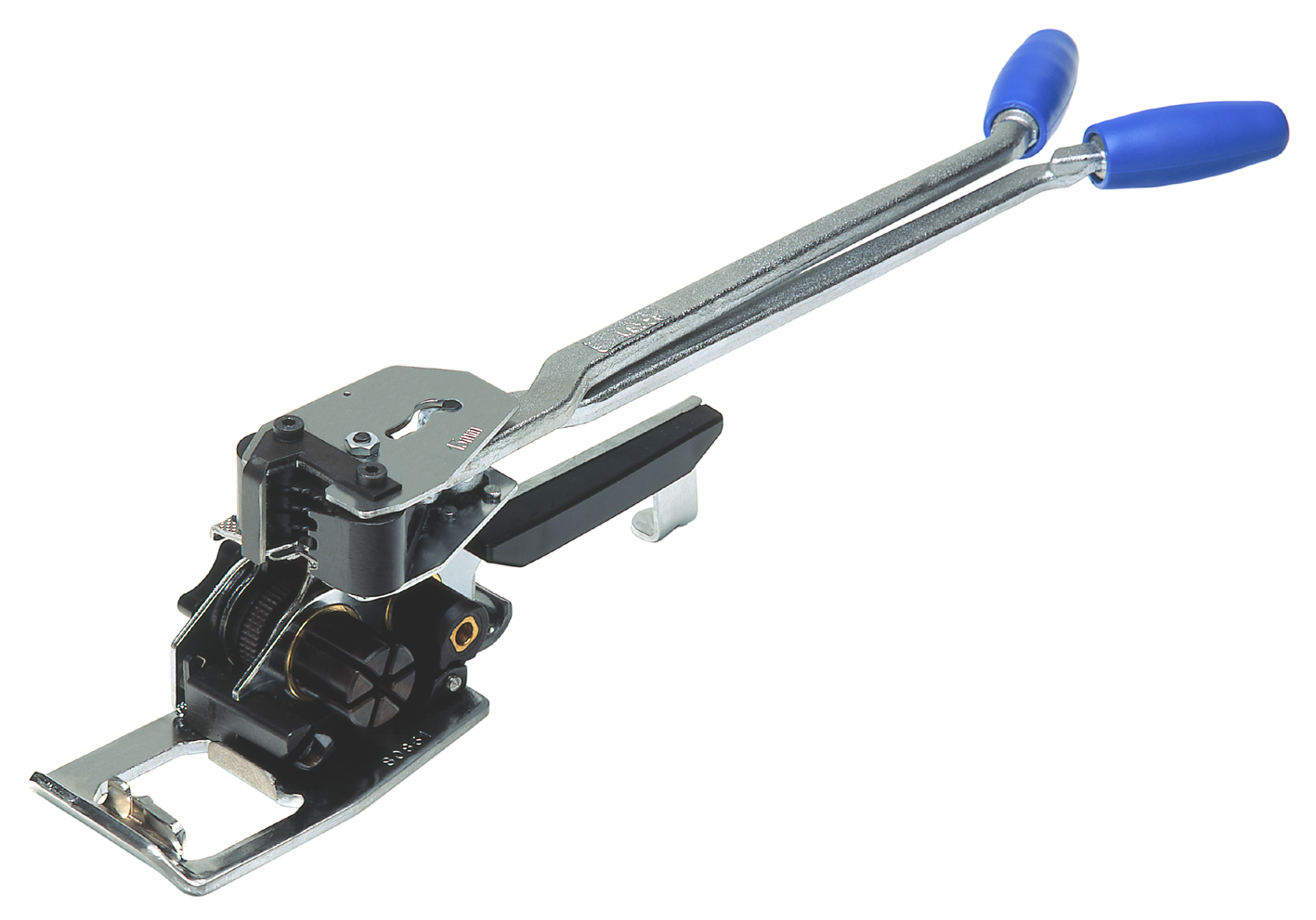
Combi PET KUD - manual tensioning and sealing device for PET straps
55 x 11 x 12 cm Band width: 16mm Thickness: 0.80mm Tape type: Polyethylene (PET) tape Closure: Crimp closure with sleeve Closure shape: central ® PET open, smooth - versatile even under poor conditions - Clamping device with easy handling - large clamping capacity - reliable crimp closure via special centra ® PET closure sleeve - Closure strength over 75% of the band strength

Combi PP KUD - manual tensioning and sealing device for PP straps
46 x 11 x 11 cm Band width: 16mm Thickness: 0.80mm Tape type: Polypropylene (PP) tape Closure: Crimp closure with sleeve Closure shape: half-open, smooth - versatile due to light weight and ideal center of gravity - Clamping device enables optimal work - large clamping capacity - reliable crimp closure with a smooth closure sleeve - Closure capability over 75% of the band strength

Combined strapping tool for 13mm PP straps
Tensioning device and sealing pliers are included in this band tensioner for 13mm PP bands with sleeve closure combined. Customs tariff number: 82055990

ITATOOLS cordless strapping tool ITA-20
ITATOOLS battery strapping tool ITA-20 for PP and PET straps with strap widths of 12 - 16mm and strap thicknesses of 0.5 to 1.05mm, with 14.8V / 2.0 Ah lithium-polymer battery and charger, maximum tension force 2,200Nm, one-hand operation , Friction closure (friction welding process), weight with battery approx. 3.8 kg Dimensions: (L x W x H) 318 x 130 x 183 mm Serial number:

ITATOOLS cordless strapping tool ITA-21
ITATOOLS battery strapping tool ITA-21 for PP and PET straps with strap widths of 16 - 19mm and strap thicknesses of 0.7 to 1.27mm, with 14.8V / 3.0 Ah lithium-polymer battery and charger, maximum tension force 3,500Nm , one-hand operation , Friction closure (friction welding process), weight with battery approx. 4.0 kg Dimensions: (L x W x H) 318 x 130 x 183 mm Serial number:

Manual strap tensioning device for PET strap 15-16mm with sleeve closure
Manual strap tensioning device for PET strap 15-16mm with sleeve closure - very robust design, (16x30mm sleeves for single-lever spanner not included) Customs tariff number: 82055980

Manual strapping tool for plastic strap 12-13 mm
The Sandax manual strapping tool is the perfect choice for anyone looking for a cost-effective, flexible, and reliable strapping solution. This high-quality combination tool was specially developed for processing PP and PET strapping with a width of 12–13 mm and a strap thickness of 0.5–1 mm . Thanks to its robust construction and integrated clamping and locking function, it enables fast and precise workflows – ideal for daily use in logistics companies, production facilities, shipping departments or in retail. Whether you want to secure boxes, pallets, machines or other transport goods : This tensioning tool ensures stable and durable strapping that reliably protects your goods. Technical details at a glance Suitable band width : 12–13 mm Suitable band thickness : 0.5–1 mm Suitable materials : PP (polypropylene) and PET (polyester) straps Closure type : sleeve closure (with metal sleeves, type 133007KUOR) Device type : Combination device with integrated clamping and locking function Customs tariff number : 84224000 Application : Packaging, logistics, industry, shipping Your benefits at a glance ✅ All in one device : The combined clamping and locking function saves you time and reduces your workload. ✅ Suitable for PP and PET strapping : Maximum flexibility as you can use both plastic polypropylene and polyester straps. ✅ High tension force, stable strapping : reliably secures pallets, packages, machines and other transport goods for storage and transport. ✅ Ergonomic and easy to use : The manual clamping tool fits comfortably in the hand and allows for comfortable work even during longer periods of use. ✅ Robust and durable : The strapping tool is made of high-quality materials and is designed for continuous use in commercial applications. ✅ Economical solution : No expensive machines or power connections required – ideal for small to medium-sized packaging lines or as a mobile device in the factory. Typical applications for the manual strapping tool Logistics and forwarding : strapping of pallets, containers or cardboard boxes for shipping. Industry and production : bundling of raw materials, products or components. Retail and mail order : packaging of goods for delivery to final customers. Crafts and construction : Securing materials and machinery for transport. Warehousing : Preparation of goods for storage or internal transport. Instructions for use of the manual strapping tool 1️⃣ Place plastic tape around the package. 2️⃣ Insert the strap end into the strapping tool. 3️⃣ Use the tension lever to create the desired tension. 4️⃣ Press the sleeve lock to firmly connect the strap ends. 5️⃣ Cut the ribbon and you’re done! Tip : Use genuine Sandax strapping and sealing sleeves to ensure maximum performance and compatibility. Why Sandax is the right choice For years, Sandax has stood for quality, innovation and practicality in packaging technology and load securing . Our products are valued by professionals in industry, trade, and logistics – because they simply work, are reliable, and perform under real conditions. With the manual strapping tool, you are investing in a tool that will noticeably simplify your everyday work. 👉 Don’t wait any longer and secure your packaging processes now – with a professional, durable clamping tool from Sandax !

PneumoCord PRC RV - left-/right-turning pneumatic tensioners for all textile straps up to 32mm
31 x 12 x 20 Friction closure with buckle (wire, key-lock, double bar) for kraftband, composite band, woven band max. 7.5 bar Clamping capacity of max. 7500N Band width / thickness: 32mm / 2.0mm - easy handling, light weight - heavy duty design, made for continuous use - maximum clamping capacity of 7500N - includes cutting unit - Various accessories available (hanging bracket, hand guard)

Signode battery strapping tool BXT3-19, for 16-19mm strap widths
The Signode BXT3-19 battery-powered strapping tool is the perfect solution for companies that need to strap large numbers of particularly heavy packages safely and efficiently every day . As the successor to the proven BXT2, the tool sets new standards in terms of ease of use, reliability, and performance . This strapping machine from Signode was developed for the highest demands in industry, logistics and shipping – wherever PET strapping or PP strapping with a width of 16-19 mm is used. Whether in pallet logistics , steel trading , or machine packaging – with the Signode BXT3-19 strapping tool, you can secure your products quickly, powerfully, and with high repeatability . Thanks to its battery operation , you can work wirelessly and flexibly – without compressed air or a power connection. Technical product details at a glance Model : Signode BXT3-19 Strap widths : 16 – 19 mm (for PET & PP strapping) Band thickness : 0.8 – 1.3 mm Closure type : Friction closure / friction welding closure (welding without closure sleeves) Clamping force : 1,300 – 4,500 N (adjustable) One-handed operation : possible Extras : Soft clamping mode Operating modes : Manual, semi-automatic, fully automatic Display : LED display with soft-touch control Battery : 18 V Li-Ion (Bosch Professional), 4.0 Ah Charging time : approx. 30–60 minutes Strappings per battery charge : up to 400 strappings (depending on strap and settings) Device weight : approx. 4.3 kg (including battery) Dimensions (L x W x H) : approx. 370 x 141 x 135 mm Accessories : Incl. 1 battery and quick charger Manufacturer : Signode – global market leader for strapping technology Advantages of the Signode BXT3-19 battery-powered strapping tool ✅ Maximum mobility thanks to battery operation : With the powerful 18 V lithium-ion battery, you can work anywhere, wirelessly and efficiently – ideal for use directly on the packaging line or in the warehouse. ✅ Versatile application with three operating modes : Choose between manual, semi-automatic or fully automatic strap tensioning and welding as required – with just the push of a button. ✅ Intuitive operation with LED display : The user-friendly interface with soft-touch buttons and display allows easy adjustment of clamping force and welding time – can also be operated with gloves. ✅ Highest clamping force for heavy packages : With a clamping force of up to 4,500 N, the device reliably secures even heavy or bulky products - ideal for the wood, steel or machine industries. ✅ Friction welding technology – completely without sleeves : The Signode strapping machine works with a low-wear friction welding process, which makes additional sleeves unnecessary – this saves costs and speeds up the packaging process. ✅ Repeatable results for process reliability : The automatic control ensures consistent results with every strapping – this reduces errors and increases packaging quality. Typical applications of the Signode battery strapping tool BXT3-19 Industry & Mechanical Engineering : Securing large parts, machines, pipes, containers or machine parts Logistics & Shipping : pallet securing, load securing , parcel and bundle packaging Timber & building materials trade : strapping of timber packages, stones, pipes or building materials Metal processing & steel trading : Bundling of raw materials or fixing heavy metal parts Scope of delivery 1 × Signode BXT3-19 battery -powered strapping tool 1 × 18 V Li-Ion battery (4.0 Ah, Bosch Professional) 1 × Fast charger Buy Signode strapping tools now at Sandax The Signode BXT3-19 battery-powered strapping tool is the right choice for anyone who values reliable technology, ease of use, and maximum mobility . Benefit from high clamping force , fast work cycles and ergonomic handling – without any compromises.
Frequency of use
- Occasional use: Manual strapping tools are sufficient for smaller businesses and occasional strapping tasks. They are affordable and easy to use.
- Regular use: Battery-powered strapping tools are better suited to more frequent applications. They offer greater efficiency and mobility.
- Intensive use: Electric and fully automatic strapping tools are ideal for businesses with high strapping volumes. They deliver consistent performance and are particularly efficient.
Costs and budget
- Budget-friendly options: Seal joints and manual strapping tools are cost-effective solutions and ideal for smaller budgets.
- Long-term investment: Automatic and fully automatic strapping tools may have higher upfront costs, but can provide long-term savings through greater efficiency and reduced labor costs.
Environmental conditions
- Indoor applications: PP and PET strapping are ideal for indoor applications. Manual and battery-powered tools are flexible and easy to use.
- Outdoor applications: PET and steel strapping are better suited to outdoor use because they are more resistant to weather conditions. Battery-powered and electric tools provide the required mobility and performance.

Manual Strapping Tools

Cordless Strapping Tools

Semi-automatic and fully automatic strapping machines
Type of strapping
- PET straps: These straps are known for their high tensile strength and resistance to
weather conditions. They are ideal for heavy loads and outdoor applications.
- PP straps: These straps are more flexible and easier to handle, making them ideal for light to
medium loads and indoor applications.
- Stahlbänder: For particularly heavy or sharp-edged loads, steel strapping offers the greatest
strength and durability.
- Textile Umreifungsbänder: Our textile strapping range includes hot-melt strapping, composite strapping, and
PES strapping band an.
Frequently Asked Questions About Strapping Tools
What is a strapping tool?
A strapping tool is used to securely bundle packages, cartons, pallets, or heavy goods with strapping and stabilize them for storage or transport. Depending on the type of tool, the strapping is tensioned, sealed, and sometimes automatically cut.
What types of strapping tools are available?
Common types include manual strapping tools, battery-powered strapping tools, and pneumatic strapping tools. Manual tools are suitable for occasional use, battery-powered models offer flexibility for regular applications, and pneumatic tools are designed for high-volume strapping operations in industry and logistics.
When is a battery-powered strapping tool worth using?
A battery-powered strapping tool is a worthwhile investment when pallets, cartons, or packages need to be strapped regularly and fast, mobile, and consistent operation is important. Since tensioning, welding, and cutting are often completed in a single operation, battery-powered strapping tools save time and reduce physical effort.
Which types of strapping are compatible with strapping tools?
Depending on the model, strapping tools are designed for different materials, such as PP strapping, PET strapping, or steel strapping. The strap width, thickness, and material must be compatible with the specific tool to ensure proper tensioning and a reliable seal.
What is the difference between PP and PET strapping?
PP strapping is commonly used for light to medium-weight packages and is particularly cost-effective. PET strapping offers higher strength and lower elongation, making it more suitable for heavy pallets, stable load units, and demanding transport conditions.
What should I consider when buying a strapping tool?
When choosing a strapping tool, the most important factors are strap material, width, thickness, tensioning force, sealing method, frequency of use, and ergonomics. For professional applications, it is also important to determine whether a manual, battery-powered, or pneumatic model is best suited to the packaging process.
Do strapping tools require additional accessories?
Depending on the tool and application, additional accessories may include strapping bands, strapping seals, buckles, dispensers, edge protectors, or spare parts. For battery-powered strapping tools, a suitable battery and charger are also essential for reliable daily operation.
How do you use a strapping tool correctly?
The strapping is placed around the package or pallet, fed into the tool, and tensioned. Depending on the type of tool, the strap is then sealed, welded, or secured with a metal seal before being cut. For reliable securing, the strapping should fit tightly without damaging the goods or packaging.
How do you clean and maintain a strapping tool?
A strapping tool should be regularly cleaned to remove dust, strap residue, and dirt. Moving parts, tensioning mechanisms, and wear components should be inspected according to the frequency of use. Regular maintenance extends the tool's service life and helps ensure consistently reliable strapping results.
Conclusion
The right strapping tool depends primarily on the type of strapping used, how often it will be used, the operating environment, and the desired level of automation. Manual tools are suitable for occasional use, while battery-powered and electric tools are better suited to higher strapping volumes. Automatic systems are ideal for continuous packaging processes. Choosing the right tool helps secure loads reliably and improve packaging efficiency. Sandax offers solutions for a wide range of requirements and can help you select the right strapping tool for your needs.