


Legal basis for load securing
- Road Traffic Regulations (StVO) : These require that the load is stowed and secured in such a way that it does not slip or fall, even in the event of sudden braking or evasive maneuvers.
- Road Traffic Licensing Regulations (StVZO) : These specify the technical requirements for vehicles and their equipment.
- Commercial Code (HGB) : Contains regulations on liability in transport law.
- Guidelines of the German Social Accident Insurance (DGUV) : Provide information on accident prevention in commercial freight transport.
Who is responsible?
1. The driver
2. The owner of the vehicle
3. The shipper
4. The sender
5. The vehicle owner or entrepreneur
Consequences of violations
- Fines and points in Flensburg for drivers and those responsible
- Liability for property damage and personal injury
- Criminal consequences in case of gross negligence or intent
Tools for securing loads

With a length of 10 meters, a width of 50 millimeters and a lashing capacity of 2500daN, this two-part lashing strap stands for strength and reliability. What makes this lashing strap special is the ERGO long-lever ratchet , which not only embodies technological advancement but also offers unique ergonomics. With this ratchet, lashing and securing your load becomes an effortless task. Sandax stands not only for performance, but also for first-class workmanship and durability – the lashing strap is a reliable companion for all your demanding transport tasks. If you're looking for the highest quality, innovative design, and uncompromising safety , the two-piece Sandax 10m ERGO lashing strap is your best choice. Invest in the safety of your cargo and trust in Sandax quality. 🚚 Note : These straps are suitable for use as truck tensioning straps and meet the current standards for load securing. This tensioning strap is TÜV certified according to ISO 9001: Find even more 50mm tensioning straps at Sandax Is this strap not the right length, or are you looking for other 50mm lashing straps ? Simply click the button to go to our category with all 50mm lashing straps . All 50mm tensioning straps at a glance

Like our 10m XXL strap, this 8m strap also offers an impressive width of 75 millimeters and a lashing capacity of 5000 daN . This two-part lashing strap is unmatched in strength and resilience. The Heavy XXL ratchet, exclusive to Sandax, gives this lashing strap unparalleled security. With an STF value of 500 daN, it enables comfortable and powerful securing of your load . Whether you're transporting heavy machinery or bulky cargo, you're playing it safe with this XXL lashing strap . Invest in top quality and trust Sandax. 🚚 Note : These straps are suitable for use as truck tensioning straps and meet the current standards for load securing.
The largest of our lashing straps. With a length of 10 meters , an impressive width of 75 millimeters , and a lashing capacity of 5000 daN, this two-part lashing strap sets new standards in strength and resilience. The Heavy XXL ratchet , exclusive to Sandax, gives this lashing strap unparalleled power. With a STF value of 500 daN, it allows for comfortable and powerful securing of your load . Whether you're transporting heavy machinery or bulky cargo, you're playing it safe with this XXL lashing strap . Invest in top quality and trust Sandax. 🚚 Note : These straps are suitable for use as truck tensioning straps and meet the current standards for load securing.
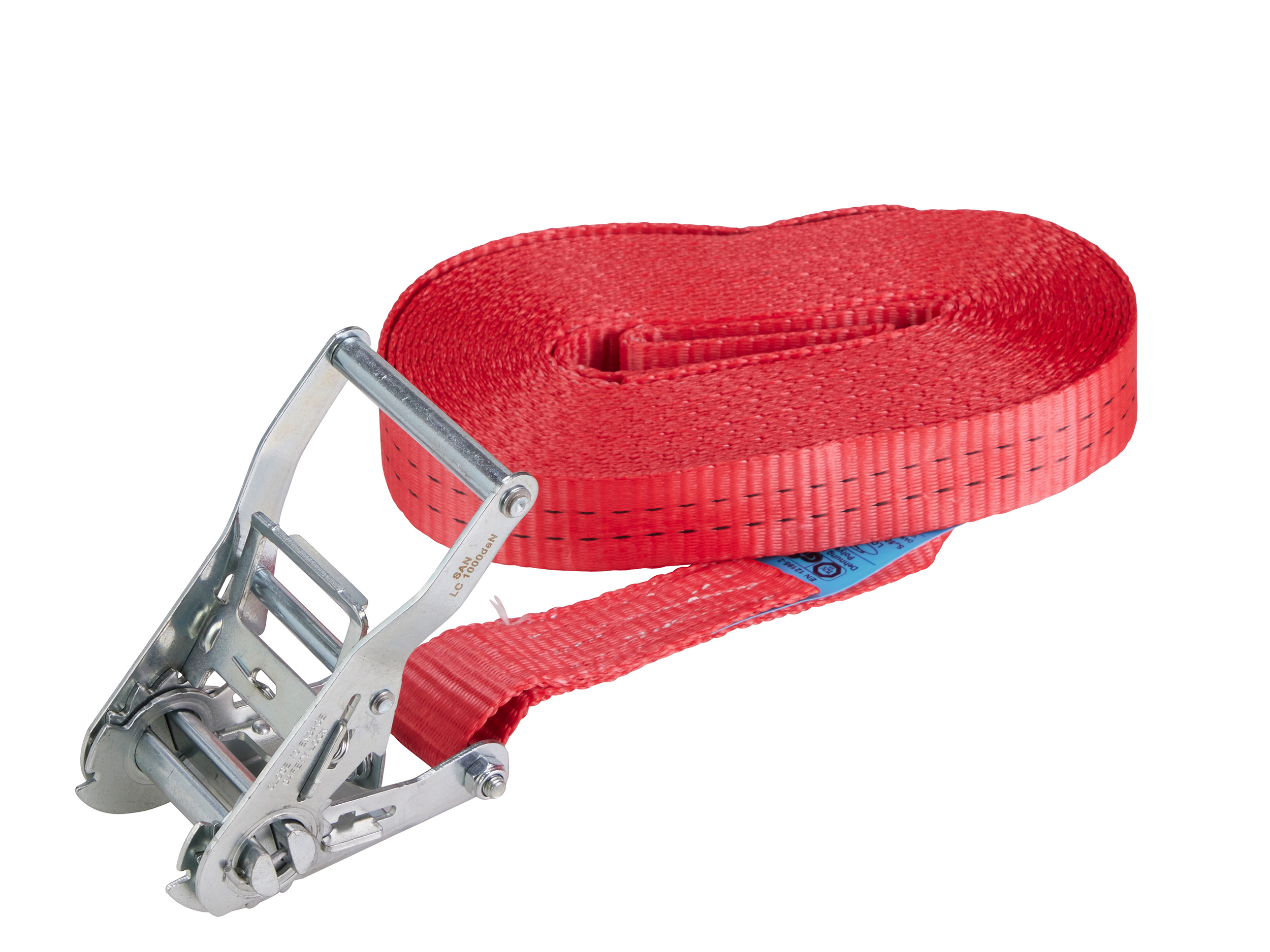
Whether for professional freight transport or private use, proper load securing is crucial. The one-piece lashing strap from Sandax , measuring 10 meters long and 35 mm wide, is ideal for securing boxes, machinery, furniture, and much more. With a lashing capacity (LC) of 2000 daN and a standard pre-tension force (STF) of 200 daN, this strap is suitable for a wide range of applications and ensures maximum safety during transport . The integrated standard ratchet made of robust steel allows for quick and easy application. Technical product details at a glance Design : One-piece with standard ratchet Length : 10 meters Width : 35 mm Lashing force (LC) : 2000 daN (straight pull) Preload force (STF) : 200 daN Material : High-strength, UV-resistant polyester Color : Red Certified : According to DIN EN 12195-2, TÜV and GS tested Labelling : Permanently sewn with all required safety information Your benefits at a glance ✅ Versatile – ideal for transport with trailers, vans, trucks or in the workshop ✅ 10 meters long – ideal for securing large or bulky loads ✅ Easy handling – thanks to the ergonomic standard ratchet with high operating comfort ✅ Durable & weatherproof – the polyester webbing is resistant to moisture, UV rays and abrasion ✅ Certified & compliant with standards – meets all requirements of DIN EN 12195-2, for safe use in commercial transport ✅ Cost-effective & reusable – long service life when used properly ✅ Safety label on the belt – with information on LC, STF, manufacturer and standard for quick check Typical applications for the 10m tensioning strap from Sandax Transport security in commercial freight transport Fastening furniture, pallets or machines Securing building materials on flatbed trucks and trailers Use by forwarding companies, tradesmen, event logistics or private removals Why Sandax? Sandax stands for quality, reliability, and safety in the field of load securing . With decades of experience and certified products, Sandax is one of the leading suppliers in Germany. Every lashing strap is tested and meets the highest standards – for your safety on the road. Order now and transport safely Rely on proven brand quality from Sandax – and ensure a secure hold during every transport. Combine the strap with other Sandax products such as edge protectors , storage bags , or anti-slip mats for a professional securing system. This tensioning strap is TÜV certified according to ISO 9001: Find even more 35mm tensioning straps at Sandax Is this strap not the right length, or are you looking for other 35mm lashing straps ? Simply click the button to go to our category with all 35mm lashing straps . All 35mm tensioning straps at a glance

Specially designed for professional use, this round shoring beam stands out with its length of up to 2750 mm and is equipped with a wider pin edge to ensure even better fixation and security. Manufactured from high-quality steel , this round shoring beam offers exceptional durability and resistance to stress and wear. Its design is precisely tailored to the requirements of the transport industry to enable optimal load securing in trucks and on trailers. Whether heavy pallets, machinery, or other bulky goods , our round shoring beam ensures a secure hold and prevents your load from slipping or tipping during transport. Invest in this reliable solution to make your transport more efficient and safer .
Conclusion on responsibilities for load securing
Download our free PDF checklist with 10 important points for load securing .
Download load securing checklist