

In the following we explain diagonal lashing , give a practical explanation of diagonal lashing and show the differences to diagonal lashing .
What is diagonal lashing?
- Diagonal lashing definition : The load is secured in such a way that it cannot move forwards, backwards or sideways.
- Diagonal lashing principle : The straps run diagonally from the lashing points on the vehicle to the load at a specific lashing angle. This creates a stable, form-fitting connection in all directions.
- Typically four straps are required – two each facing forward and two facing backward.
What is diagonal lashing?
- With diagonal lashing, the straps are not led diagonally across, but diagonally from the lashing points on the vehicle to the load.
- The aim is also to provide force-locking security in several directions.
- The method is often used when there is not enough space for the classic diagonal lashing.
The correct lashing angle for diagonal lashing
- Vertical angle (α) : Should be between 30° and 60°.
- Horizontal angle (β) : Optimal between 6° and 55°.

With a length of 10 meters, a width of 50 millimeters and a lashing capacity of 2500daN, this two-part lashing strap stands for strength and reliability. What makes this lashing strap special is the ERGO long-lever ratchet , which not only embodies technological advancement but also offers unique ergonomics. With this ratchet, lashing and securing your load becomes an effortless task. Sandax stands not only for performance, but also for first-class workmanship and durability – the lashing strap is a reliable companion for all your demanding transport tasks. If you're looking for the highest quality, innovative design, and uncompromising safety , the two-piece Sandax 10m ERGO lashing strap is your best choice. Invest in the safety of your cargo and trust in Sandax quality. 🚚 Note : These straps are suitable for use as truck tensioning straps and meet the current standards for load securing. This tensioning strap is TÜV certified according to ISO 9001: Find even more 50mm tensioning straps at Sandax Is this strap not the right length, or are you looking for other 50mm lashing straps ? Simply click the button to go to our category with all 50mm lashing straps . All 50mm tensioning straps at a glance

Like our 10m XXL strap, this 8m strap also offers an impressive width of 75 millimeters and a lashing capacity of 5000 daN . This two-part lashing strap is unmatched in strength and resilience. The Heavy XXL ratchet, exclusive to Sandax, gives this lashing strap unparalleled security. With an STF value of 500 daN, it enables comfortable and powerful securing of your load . Whether you're transporting heavy machinery or bulky cargo, you're playing it safe with this XXL lashing strap . Invest in top quality and trust Sandax. 🚚 Note : These straps are suitable for use as truck tensioning straps and meet the current standards for load securing.
The largest of our lashing straps. With a length of 10 meters , an impressive width of 75 millimeters , and a lashing capacity of 5000 daN, this two-part lashing strap sets new standards in strength and resilience. The Heavy XXL ratchet , exclusive to Sandax, gives this lashing strap unparalleled power. With a STF value of 500 daN, it allows for comfortable and powerful securing of your load . Whether you're transporting heavy machinery or bulky cargo, you're playing it safe with this XXL lashing strap . Invest in top quality and trust Sandax. 🚚 Note : These straps are suitable for use as truck tensioning straps and meet the current standards for load securing.
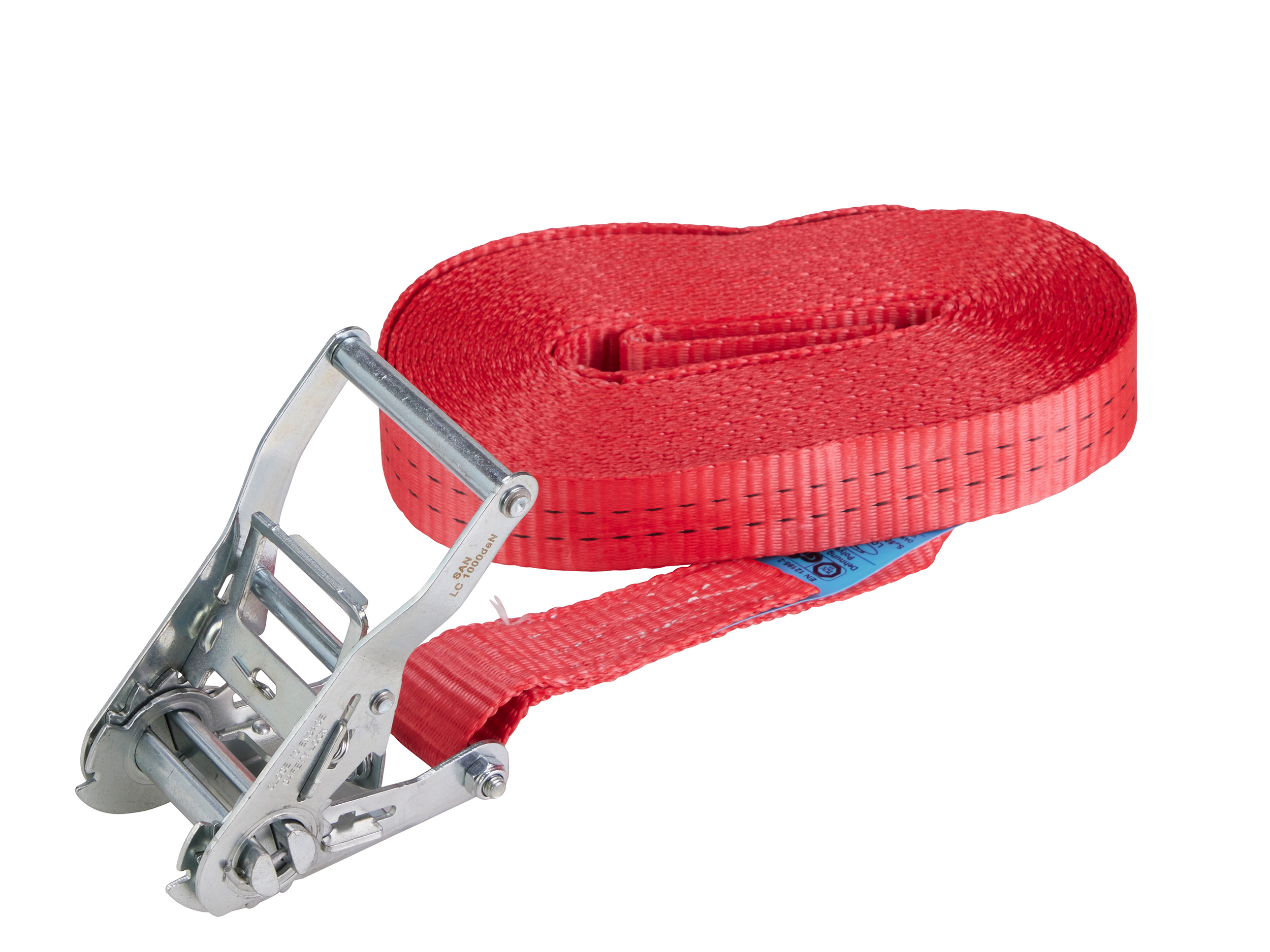
Whether for professional freight transport or private use, proper load securing is crucial. The one-piece lashing strap from Sandax , measuring 10 meters long and 35 mm wide, is ideal for securing boxes, machinery, furniture, and much more. With a lashing capacity (LC) of 2000 daN and a standard pre-tension force (STF) of 200 daN, this strap is suitable for a wide range of applications and ensures maximum safety during transport . The integrated standard ratchet made of robust steel allows for quick and easy application. Technical product details at a glance Design : One-piece with standard ratchet Length : 10 meters Width : 35 mm Lashing force (LC) : 2000 daN (straight pull) Preload force (STF) : 200 daN Material : High-strength, UV-resistant polyester Color : Red Certified : According to DIN EN 12195-2, TÜV and GS tested Labelling : Permanently sewn with all required safety information Your benefits at a glance ✅ Versatile – ideal for transport with trailers, vans, trucks or in the workshop ✅ 10 meters long – ideal for securing large or bulky loads ✅ Easy handling – thanks to the ergonomic standard ratchet with high operating comfort ✅ Durable & weatherproof – the polyester webbing is resistant to moisture, UV rays and abrasion ✅ Certified & compliant with standards – meets all requirements of DIN EN 12195-2, for safe use in commercial transport ✅ Cost-effective & reusable – long service life when used properly ✅ Safety label on the belt – with information on LC, STF, manufacturer and standard for quick check Typical applications for the 10m tensioning strap from Sandax Transport security in commercial freight transport Fastening furniture, pallets or machines Securing building materials on flatbed trucks and trailers Use by forwarding companies, tradesmen, event logistics or private removals Why Sandax? Sandax stands for quality, reliability, and safety in the field of load securing . With decades of experience and certified products, Sandax is one of the leading suppliers in Germany. Every lashing strap is tested and meets the highest standards – for your safety on the road. Order now and transport safely Rely on proven brand quality from Sandax – and ensure a secure hold during every transport. Combine the strap with other Sandax products such as edge protectors , storage bags , or anti-slip mats for a professional securing system. This tensioning strap is TÜV certified according to ISO 9001: Find even more 35mm tensioning straps at Sandax Is this strap not the right length, or are you looking for other 35mm lashing straps ? Simply click the button to go to our category with all 35mm lashing straps . All 35mm tensioning straps at a glance

With the 6-piece set of 3m clamp lock straps from Sandax , you're making the optimal choice for transporting light loads from A to B. With a width of 25mm and a lashing capacity of 250 daN, these high-quality clamp lock straps will keep your light load secure. The blue polyester webbing features robust clamp locks that allow for quick, easy, and secure locking. Our state-of-the-art strap set is ideal for everyday use at home or in businesses.

Our 6 m long lashing strap with reflective stripes is the ultimate solution for securing your cargo while traveling! This two-piece, 35 mm wide strap gives you peace of mind when transporting your goods, as it has a lashing capacity of 1000 daN . The integrated reflective stripes ensure particularly good visibility in traffic. Get ready for safe transport with this lashing strap . Find even more 35mm tensioning straps at Sandax Is this strap not the right length, or are you looking for other 35mm lashing straps ? Simply click the button to go to our category with all 35mm lashing straps . All 35mm tensioning straps at a glance

This high-quality , two-part tensioning strap is made of 50mm wide woven polyester webbing and is ideal for securing loads on Krone trailers. The fixed end is 0.5m long, and the loose end is 7.5m long. It features low stretch of less than 5% and solid tensile strength. Our 8m lashing strap for Krone trailers has an LC value of 2500 daN. The ratchet has a pre-tensioning force of 300 daN and can be easily re-tensioned if tensile force is lost . The ratchet strap complies with DIN EN 12195-2 and is TÜV-certified . There are 320 pieces on a pallet, 10 pieces per carton. 🚚 Note : These straps are suitable for use as truck tensioning straps and meet the current standards for load securing.

6m lashing strap, two-part - 25mm - LC 400/800daN, STF 120daN - Standard ratchet Loose and fixed end with flat hook for rack system - Color: gray PU=40 pieces/box, 1280 pieces/pallet manufactured according to DIN EN 12195-2, TÜV certificate Find even more 25mm tensioning straps at Sandax Is this strap not the right length, or are you looking for other 25mm lashing straps ? Simply click the button to go to our category with all 25mm lashing straps . All 25mm tensioning straps at a glance

This two-part lashing strap , 8 meters long and 50 millimeters wide, is specially designed for demanding applications in professional load securing . With its high load capacity of 2500 daN in a straight line and a pre-tensioning force of 350 daN, the tensioning strap ensures a firm hold and reliable protection for a wide variety of transported goods . Thanks to its robust design and manufacturing in accordance with DIN EN 12195-2 and TÜV certification, the strap meets all relevant safety and quality standards. Features and Benefits ✅ Two sections per belt: fixed end with 0.4 m and loose end with 7.6 m, both with claw hooks ✅ High-quality short lever ratchet for efficient preload ✅ Durable webbing with a width of 50 mm and low stretch of <5% ✅ Load capacity up to 2.5 tons (LC 2500 daN) ✅ TÜV-certified and manufactured according to current standards Technical details Length : 8 m (fixed end 0.4 m / loose end 7.6 m) Width : 50 mm Lashing Capacity : 2,500 daN Preload force : 350 daN Color : Red Certification : DIN EN 12195-2, ISO 9001 TÜV Packaging unit : pallet=320 pieces, 10 pieces per carton Typical applications of the 8m lashing strap Load securing on trucks and vans Fixing of pallets and boxes Securing machines and heavy components Storing construction site materials Application in industrial freight transport Your added value when purchasing With Sandax lashing straps, you get proven brand quality and a straightforward, secure solution for a wide range of load securing tasks. These lashing straps are ideal for users who value durable materials, reliable functionality, and compliance with load securing standards . 🚚 Note : These straps are suitable for use as truck tensioning straps and meet the current standards for load securing. This tensioning strap is TÜV certified according to ISO 9001: Find even more 50mm tensioning straps at Sandax Is this strap not the right length, or are you looking for other 50mm lashing straps ? Simply click the button to go to our category with all 50mm lashing straps . All 50mm tensioning straps at a glance
Differences between diagonal lashing and diagonal lashing
| criterion | Diagonal lashing | diagonal lashing |
|---|---|---|
| Number of belts | 4 (crosswise) | usually 2–4 (oblique) |
| Form closure | In all directions | In selected directions |
| Lashing angle | precisely calculated | more flexible, depending on the structure |
| Application | heavy, compact load | limited space |
| Principle of operation | full bracing | partial guying |
Both methods are recognized methods of securing loads and are justified depending on the type of transport.
Diagonal lashing – practical example
Conclusion on diagonal lashing vs. diagonal lashing
- Diagonal lashing offers maximum stability through positive securing in all directions.
- Diagonal lashing is a flexible alternative in confined spaces.