

What is tie-down lashing?
How does lashing work?
- The weight of the load : The heavier the load, the higher the natural friction.
- The coefficient of friction : This describes the properties of the contact surfaces. A non-slip surface, such as an anti-slip mat, increases the coefficient of friction.
Advantages of lashing down
- Easy to use : Lashing down does not require any complex tools and can be carried out quickly.
- Versatility : This method is suitable for a wide range of loads, from boxes and pallets to bulky goods.
- Cost efficiency : Effective securing can be achieved with just a few tensioning straps and lashing points.
- Flexibility : Tie-down lashing can be used in combination with other load securing methods, such as form-fitting.
In which situations is tie-down lashing used?
- Flat loads : pallets, boxes or machines with a large support surface.
- Light to medium-weight goods : For heavy goods, additional positive locking may be necessary.
- Non-slip surfaces : The effect of lashing down is enhanced by anti-slip mats or coated loading surfaces.
Limits and risks of lashing down
- Limited securing force : For very heavy or high loads, lashing down is often not sufficient.
- Loss of tension : The belts can give way while driving, which makes regular checks necessary.
- Damage to the load : Over-lashing can damage delicate goods, so the pressure should be carefully adjusted.
How to lash down correctly
- Preparing the loading area : Use non-slip pads or anti-slip mats to increase friction.
- Positioning of the load : Make sure that the load is evenly distributed on the loading area.
- Attaching the lashing straps : Place the straps over the load and attach them to the vehicle's lashing points.
- Tightening the straps : Tighten the straps with the ratchet so that the load is pressed down.
- Check the tension : Check the tension of the belts regularly before and during the journey.
Legal requirements for lashing down
Conclusion: Lashing as an effective securing method
Tension straps for lashing down

With a length of 10 meters, a width of 50 millimeters and a lashing capacity of 2500daN, this two-part lashing strap stands for strength and reliability. What makes this lashing strap special is the ERGO long-lever ratchet , which not only embodies technological advancement but also offers unique ergonomics. With this ratchet, lashing and securing your load becomes an effortless task. Sandax stands not only for performance, but also for first-class workmanship and durability – the lashing strap is a reliable companion for all your demanding transport tasks. If you're looking for the highest quality, innovative design, and uncompromising safety , the two-piece Sandax 10m ERGO lashing strap is your best choice. Invest in the safety of your cargo and trust in Sandax quality. 🚚 Note : These straps are suitable for use as truck tensioning straps and meet the current standards for load securing. This tensioning strap is TÜV certified according to ISO 9001: Find even more 50mm tensioning straps at Sandax Is this strap not the right length, or are you looking for other 50mm lashing straps ? Simply click the button to go to our category with all 50mm lashing straps . All 50mm tensioning straps at a glance

Like our 10m XXL strap, this 8m strap also offers an impressive width of 75 millimeters and a lashing capacity of 5000 daN . This two-part lashing strap is unmatched in strength and resilience. The Heavy XXL ratchet, exclusive to Sandax, gives this lashing strap unparalleled security. With an STF value of 500 daN, it enables comfortable and powerful securing of your load . Whether you're transporting heavy machinery or bulky cargo, you're playing it safe with this XXL lashing strap . Invest in top quality and trust Sandax. 🚚 Note : These straps are suitable for use as truck tensioning straps and meet the current standards for load securing.
The largest of our lashing straps. With a length of 10 meters , an impressive width of 75 millimeters , and a lashing capacity of 5000 daN, this two-part lashing strap sets new standards in strength and resilience. The Heavy XXL ratchet , exclusive to Sandax, gives this lashing strap unparalleled power. With a STF value of 500 daN, it allows for comfortable and powerful securing of your load . Whether you're transporting heavy machinery or bulky cargo, you're playing it safe with this XXL lashing strap . Invest in top quality and trust Sandax. 🚚 Note : These straps are suitable for use as truck tensioning straps and meet the current standards for load securing.
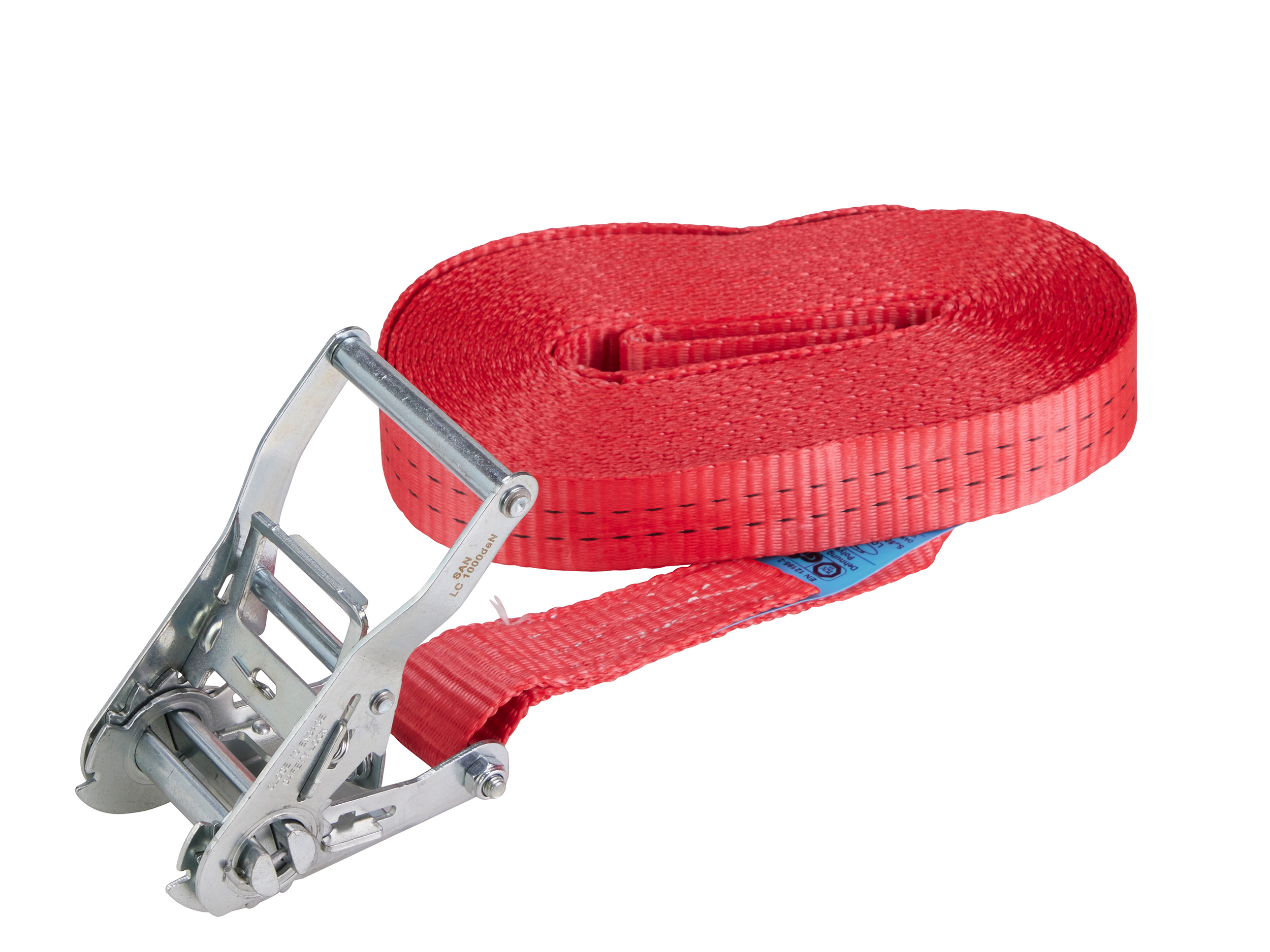
Whether for professional freight transport or private use, proper load securing is crucial. The one-piece lashing strap from Sandax , measuring 10 meters long and 35 mm wide, is ideal for securing boxes, machinery, furniture, and much more. With a lashing capacity (LC) of 2000 daN and a standard pre-tension force (STF) of 200 daN, this strap is suitable for a wide range of applications and ensures maximum safety during transport . The integrated standard ratchet made of robust steel allows for quick and easy application. Technical product details at a glance Design : One-piece with standard ratchet Length : 10 meters Width : 35 mm Lashing force (LC) : 2000 daN (straight pull) Preload force (STF) : 200 daN Material : High-strength, UV-resistant polyester Color : Red Certified : According to DIN EN 12195-2, TÜV and GS tested Labelling : Permanently sewn with all required safety information Your benefits at a glance ✅ Versatile – ideal for transport with trailers, vans, trucks or in the workshop ✅ 10 meters long – ideal for securing large or bulky loads ✅ Easy handling – thanks to the ergonomic standard ratchet with high operating comfort ✅ Durable & weatherproof – the polyester webbing is resistant to moisture, UV rays and abrasion ✅ Certified & compliant with standards – meets all requirements of DIN EN 12195-2, for safe use in commercial transport ✅ Cost-effective & reusable – long service life when used properly ✅ Safety label on the belt – with information on LC, STF, manufacturer and standard for quick check Typical applications for the 10m tensioning strap from Sandax Transport security in commercial freight transport Fastening furniture, pallets or machines Securing building materials on flatbed trucks and trailers Use by forwarding companies, tradesmen, event logistics or private removals Why Sandax? Sandax stands for quality, reliability, and safety in the field of load securing . With decades of experience and certified products, Sandax is one of the leading suppliers in Germany. Every lashing strap is tested and meets the highest standards – for your safety on the road. Order now and transport safely Rely on proven brand quality from Sandax – and ensure a secure hold during every transport. Combine the strap with other Sandax products such as edge protectors , storage bags , or anti-slip mats for a professional securing system. This tensioning strap is TÜV certified according to ISO 9001: Find even more 35mm tensioning straps at Sandax Is this strap not the right length, or are you looking for other 35mm lashing straps ? Simply click the button to go to our category with all 35mm lashing straps . All 35mm tensioning straps at a glance

With the 6-piece set of 3m clamp lock straps from Sandax , you're making the optimal choice for transporting light loads from A to B. With a width of 25mm and a lashing capacity of 250 daN, these high-quality clamp lock straps will keep your light load secure. The blue polyester webbing features robust clamp locks that allow for quick, easy, and secure locking. Our state-of-the-art strap set is ideal for everyday use at home or in businesses.

Our 6 m long lashing strap with reflective stripes is the ultimate solution for securing your cargo while traveling! This two-piece, 35 mm wide strap gives you peace of mind when transporting your goods, as it has a lashing capacity of 1000 daN . The integrated reflective stripes ensure particularly good visibility in traffic. Get ready for safe transport with this lashing strap . Find even more 35mm tensioning straps at Sandax Is this strap not the right length, or are you looking for other 35mm lashing straps ? Simply click the button to go to our category with all 35mm lashing straps . All 35mm tensioning straps at a glance

Our set of six 6m long red clamp buckle straps ensures your cargo is secure during transport. Made from high-quality materials, these 25mm wide straps have a lashing capacity of 250 daN and offer maximum security, so you can be sure that every secured item will remain safe throughout your entire journey. Thanks to the high-quality clamp buckle, the strap can be attached effortlessly and easily, making it ideal for private use, e.g., for your next trip with a caravan or motorhome . With their reliable, secure hold, these red clamp buckle straps are the perfect product for anyone who values the security of their belongings.

Introducing our 6 m lashing strap , which is 25 mm wide and has a lashing capacity of 400 daN . This two-piece strap is perfect for long distances and demanding situations where you need extra security and reliability . Equipped with an S-hook and safety device, the strap is suitable for all types of travel and transport. Likewise, in private use—whether transporting furniture for a move or leisure equipment for a weekend getaway—the peace of mind that your cargo is secure can make all the difference. The perfect accessory for use on and off the road . Find even more 25mm tensioning straps at Sandax Is this strap not the right length, or are you looking for other 25mm lashing straps ? Simply click the button to go to our category with all 25mm lashing straps . All 25mm tensioning straps at a glance

This high-quality , two-part tensioning strap is made of 50mm wide woven polyester webbing and is ideal for securing loads on Krone trailers. The fixed end is 0.5m long, and the loose end is 7.5m long. It features low stretch of less than 5% and solid tensile strength. Our 8m lashing strap for Krone trailers has an LC value of 2500 daN. The ratchet has a pre-tensioning force of 300 daN and can be easily re-tensioned if tensile force is lost . The ratchet strap complies with DIN EN 12195-2 and is TÜV-certified . There are 320 pieces on a pallet, 10 pieces per carton. 🚚 Note : These straps are suitable for use as truck tensioning straps and meet the current standards for load securing.

These high-quality, one-piece 4 m tie-down straps are 25 mm wide and have a LC value of 900 daN, making them ideal for securing your cargo . The red color gives these straps a striking look that's guaranteed to stand out from the crowd . Whether you're a hobby camper, a van driver, or simply a busy courier, these tie-down straps are perfect for everyday use and will keep your valuable belongings safe and secure, guaranteed during every transport! Find even more 25mm tensioning straps at Sandax Is this strap not the right length, or are you looking for other 25mm lashing straps ? Simply click the button to go to our category with all 25mm lashing straps . All 25mm tensioning straps at a glance

This heavy-duty tensioning strap is 50 mm wide and offers a lashing capacity of 5000 daN . Manufactured according to the quality standards of DIN EN 12195-2 and TÜV-certified, this strap features a short-lever ratchet that allows you to easily secure your load. Whether you're transporting heavy goods or stabilizing bulky cargo, this 12-meter-long strap will get the job done. The Sandax lashing strap delivers the high performance you expect. 🚚 Note : These straps are suitable for use as truck tensioning straps and meet the current standards for load securing. This tensioning strap is TÜV certified according to ISO 9001: Find even more 50mm tensioning straps at Sandax Is this strap not the right length, or are you looking for other 50mm lashing straps ? Simply click the button to go to our category with all 50mm lashing straps . All 35mm tensioning straps at a glance
FAQ – Niederzurren in der Ladungssicherung
Wann wird Niederzurren eingesetzt?
- palettierte Waren
- Kartons oder Kisten
- Maschinen und Geräte
- Baumaterialien
Was ist der Unterschied zwischen Niederzurren und Direktzurren?
Welche Hilfsmittel werden beim Niederzurren verwendet?
- Spanngurte oder Zurrgurte
- Antirutschmatten
- Kantenschoner
- geeignete Zurrpunkte am Fahrzeug
Wie viele Spanngurte werden beim Niederzurren benötigt?
- Gewicht der Ladung
- Reibungsbeiwert zwischen Ladung und Ladefläche
- Vorspannkraft der Zurrgurte
- Anzahl der Zurrpunkte
Welche Fehler sollten beim Niederzurren vermieden werden?
- zu wenige Spanngurte
- ungleichmäßig gespannte Gurte
- beschädigte oder verschlissene Zurrmittel
- fehlende Kantenschoner
- zu geringe Reibung zwischen Ladung und Ladefläche