


Lashing straps with hooks
Sandax tensioning straps with hooks
for professional use
Lashing straps with hooks
Sandax tensioning straps with hooks
for professional use
Buy tensioning straps with hooks from Sandax: S-hooks, claw hooks & Co.
Lashing straps with hooks are a reliable solution for secure load securing – whether for short distances, during relocation, or in professional freight transport. Thanks to their robust construction and various hook types , such as S-hooks, S-hooks with locking devices , or pointed hooks , lashing straps with hooks can be flexibly and quickly adapted to different transport requirements and can therefore be a decisive factor for load securing in professional and private transport .
The Sandax range offers a wide selection of tensioning straps with hooks , suitable for almost every application: from small tensioning straps for light loads to particularly sturdy versions for heavy transport . All models comply with current safety standards and ensure that your load remains reliably and securely lashed. If you require larger quantities , you can always request a customized quote from us instead of purchasing directly from our online shop.
Overview: Sandax tensioning straps with hooks
The following tensioning straps with hooks are always in stock. If you need a tensioning strap not listed here, please contact us.
What are tie-down straps with hooks?
- Tension straps with hooks are made of a high-strength webbing made of polyester or polypropylene.
- At the ends there are sturdy hooks, usually designed as pointed, S-shaped or flat hooks.
- They are used to hook the ends of the strap onto attachment points – e.g., eyelets, rails, bodywork – and secure the load.
- The pulling force can be applied to the belt via a ratchet, a clamp lock or anautomatic mechanism .
Structure and functionality
A typical tensioning strap with hooks consists of the following components:
- webbing: Usually made from particularly tensile, abrasion-resistant polyester.
- End fittings: The hooks are used for secure fastening.
- clamping mechanism: Ratchet or clamp lock for controlled tension.
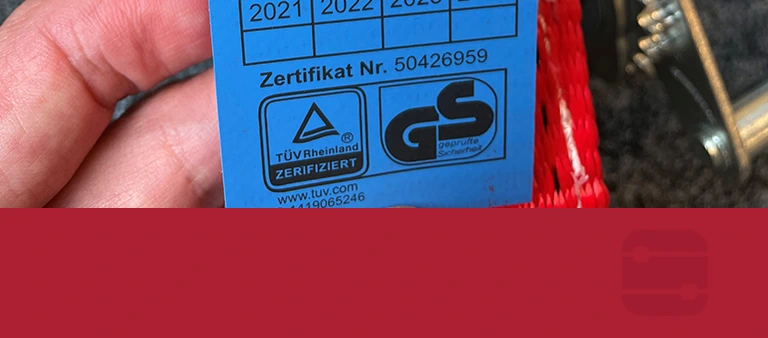
- Label: Specification of the permissible load values (LC, STF, etc.).
- seams: Color-coded depending on load and certifications.
| ingredient | function | Typical variants |
|---|---|---|
| webbing | Traction force transfer to the load | Polyester, polypropylene, various lengths/widths |
| Hook | Attachment to lashing points | S-hooks, claw hooks, flat hooks, snap hooks |
| clamping mechanism | Generating and maintaining the voltage | Ratchet, clamp lock, automatic |
| Label | Information on load/certification | DIN EN 12195-2, TÜV/GS |
Areas of application for tensioning straps with hooks
- Load securing on trucks and vans
- Securing motorcycles and cars on trailers
- Removals and furniture transport
- Bicycle or luggage attachment on roof racks
- DIY and gardening (e.g. wood or component transport)
- Bundling and securing materials (construction site, warehouse)
Advantages of tensioning straps with hooks
- Flexible fastening: Hooks fit almost any eyelet or rail.
- High resilience: Depending on the model, several hundred to over 5,000 kg of pulling force.
- Quick installation: No knotting or complicated threading required.
- Diverse selection: Different lengths, widths, and hook types are available. Common widths include: 25mm tension straps , 35mm tension straps , and 50mm tension straps.
- Security certificates: TÜV, GS and DIN standards ensure a high level of safety.
The most important types of hooks at a glance
| Hook type | Description | Typical application | Features |
|---|---|---|---|
| S-hook | Open S-shape, quick installation | Cars, motorcycles, small transports | Flexible, lightweight, for frequent changing |
| Claw hook | Pointed, closed hook | Trucks, larger loads | Extra strong, secure hold, higher load capacity |
| Flat hook | Wide, open hook | Vehicles with lashing rails, pallet securing | High surface contact, protects material |
| snap hook | With safety spring, prevents accidental release | Demanding load securing | Very safe, for demanding applications |
Technical characteristics and standards
- Almost all high-quality tensioning straps are certified according to DIN EN 12195-2.
- Material mostly high-strength polyester (PES), low stretch and high tear resistance.
- Load capacity (LC): Depending on belt width/thickness 250–5,000 daN (kg).
- System length: Available from 0.5m (short tensioning strap) to over 12m for large loads.
| criterion | Value/Range | standard |
|---|---|---|
| Traction force (LC) | 250–5,000 daN | DIN EN 12195-2 |
| material | Polyester (PES) | DIN, TÜV/GS |
| Width | 19mm – 50mm (standard) | - |
| length | from 0.5m to 12m+ | - |
| Security | GS/TÜV tested, double stitched | DIN, TÜV/GS |
Application examples for tensioning straps with hooks
- Load securing in the truck: Secure heavy pallets with multiple lashing straps and claw hooks.
- Furniture transport: S-hooks for quickly attaching furniture in the Sprinter.
- Motorcycle transport: Use lashing straps with snap hooks on the transport trailer.
- Bundle moving boxes: Short tensioning straps with hooks for secure fastening.
- Material on roof racks: Flat hooks for large-area hold on the vehicle roof.
Tips for safe use
- Never let the tensioning strap run over sharp edges (use edge protectors).
- Only use durable lashing points and eyelets.
- Never connect two hooks “piggyback” together (loss of stability is possible).
- The hook opening must fit the fastening eyelet, otherwise there is a risk of levering out or bending.
- Check belts regularly for wear (damage, abrasion, cracks).
- Use only certified, labeled products.
Maintenance and care of tensioning straps with hooks
- Check for damage after each use.
- Do not clean with aggressive cleaners, clear water is sufficient.
- Store straps in a dry place and avoid strong UV radiation or chemicals.
- Oil/grease the clamping mechanism (ratchet, lock) regularly.
- Dispose of and replace defective belts immediately!
Comparison of clamping mechanisms
| mechanism | Advantages | Disadvantages | Typical use |
|---|---|---|---|
| ratchet | Very high preload, secure hold | Requires some practice, higher price | Heavy loads, professional application |
| clamp lock | Quickly tensioned, easy to release | Lower preload force, not for heavy loads | Small transports, bicycles, luggage |
| Automatic | Automatic rewind, convenient | Usually less power, more expensive | Occasional users, private sector |
Tension strap variants with hooks: Overview
- Simple tensioning strap with S-hook : For small to medium loads
- Tension strap set with claw hooks : Ideal for trucks and professional logistics
- Small tensioning straps with hooks : Perfect for the car, bike or camping
- Short tensioning straps with hook and eye: Flexible connection and bundling possible
- Black tension straps with hooks : Modern look, unobtrusive and stylish
Important information for choosing the right tensioning strap with hooks
- Adapt load capacity (load-bearing capacity, LC) to the intended use.
- If necessary, choose the length of the belt generously – if in doubt, it is better to make it too long than too short.
- Choose the hook shape to match the lashing points.
- When transporting delicate cargo, use soft, wide straps and large hooks.
- Colored straps make it easier to assign them to specific loads or vehicles.
Frequently asked questions (FAQ) about tensioning straps with hooks
- S-hooks are ideal for quick handling, while claw hooks are ideal for heavy-duty transport and professional use. Flat hooks and carabiners offer maximum security and hold securely even during demanding operations.
- Yes! A visual inspection is mandatory before every transport. Replace damaged, torn, or frayed straps immediately.
- For insurance and safety reasons, never! If in doubt, always replace.
- No, this can lead to an unfavorable load and impair the security.
- Many manufacturers offer custom designs in terms of length, color, or hook shape. Company logos can also be incorporated.
Which type of tension strap hook is suitable for me?
Does a tensioning strap need to be checked regularly?
Can I continue to use old, worn-out tensioning straps?
Can I attach multiple hooks to one lashing point?
Are there custom-designed tension straps with hooks?
Ordering tips: What you should pay attention to
- Pay attention to the LC (permissible tensile force) and STF (standard tension) specifications.
- Demand understandable marking and a clearly legible label.
- For frequent transport, we recommend a set of tensioning straps in different lengths.
- Choose black to make dirt less visible or color to mark different areas of use.
Conclusion: Tension straps with hooks – professional load securing for all purposes
Whether for moving, construction site use, or in trucks – tensioning straps with hooks have become indispensable in the modern world of transportation. They enable quick, flexible, and standard-compliant securing of a wide variety of loads , thus protecting against damage and accidents. Choose the right tensioning strap with hooks for your project, paying attention to quality, load capacity, and the right hook type . Also consider our tensioning straps with special fittings if you need a different fitting.
With the right selection and application, you will benefit from long-term safety and comfort – and always ensure that your load is held optimally .